Showing posts with label Martin County. Show all posts

Thursday, March 19, 2020

     General Jeremiah Slade was born in 1775 in Martin County, NC. He served in the state House of Commons from 1797 to 1800 and as a state senator from 1809 to 1815. He was a Brigadier General in the War of 1812. He commanded the Fifth Brigade of the Seventh NC Division of Militia which included recruits from Martin, Edgecombe, Halifax and Northampton Counties. Slade died in 1824.
    Beginning on June 27th, 1819, Gen. Slade traveled from Martin County, NC to Nashville, TN. His daily diary of the trip seems to present a curmudgeon who found fault with many things along the way. We will not go all the way with him, but will follow him until he reaches the University in Chapel Hill.
27th.
 Dined at John Griffin's, stopped at Wilson Sherrod's, fed and rested my horse, bill 25cs., and arrived at Tarboro [Edgecombe County] that evening.
28th. 
After arranging some private business and visiting my friends with whom I had some agreeable conversation on the subject of my journey, set out about 10 o'clock, bill Mrs. Gregory $1.50, McWilliam $1.20. By 121/2 arrived at Mr. W. Parker's to dinner, spent about 2 hours in very agreeable conversation with him and his amiable lady; bill 50cs. Set out at 3 o'clock, stopped at Daniels a few minutes to have my horse watered and get some grog, went on, met very unexpectedly an old acquaintance, Mr, James Blount, from Georgia. After usual ceremonies went on and arrived at sundown at the well known stand in Nash County, Mr. J. T's, where I put up the night. Went to bed supperless. Saw there all the features of uncivilized life and that Mr. T 's daughters though unmarried all had separate names, as Polly H , Ann B &c. 
29th.
Set off from T 's before sunrise. Bill 50cs. Memo. a lame man with a blind horse staid last night at T's who had been eight days traveling from Raleigh there, only thirty-five miles. Arrived at Major Alford's to Breakfast, where I met with every attention, and treated very hospitably. Bill 50cs. Arrived at Raleigh [Wake County] at 12 o'clock, at Col. Cooke's. After dinner having dressed strolled out to stroll up and down the principal streets without appearing to notice one of the puffed little great men of the city, being resolved to observe as little ceremony towards them as they are usually in the habit of showing to all strangers, and after visiting my cousins at Mrs. Pullum's, conversing with them for a while, I returned to my lodgings. In course of the day had occasion to call on the deputy clerk of the Federal court on business, was ushered into his office with all the hauteur of a French exciseman, and treated with every mark of supercilious pride and haughty arrogance and finally dismissed with contempt. After supper I retired  to my room where I was visited by J. B. Slade, my relation, who staid with me all night & we pass the time much more agreeable than I had done during the day. 
30th. 
Left Raleigh at Sunrise, Bill $2.00 with a perfect confirmation of former opinion "that the citizens are a perfeet set of blood suckers who prey upon the vitals of the State and wallow in luxuriant indolence." Arrive at Jones' to brkft, ; bill (60cs. Arrived at Chapell that evening in a severe shower of Rain ( which tho' not so agreeable to my situation was most acceptable to visitors to that part of the country, as it was and had been for some time so dry as to endanger the crops of corn in all the upper country. Wheat crops uncommonly good, price 25cs per bus. & and little or no demand for it at that or even any price). At Mrs. Mitchell's Hotel was met and greeted as soon as arrived by cousin Jeremiah and Thomas B. Slade, dined, after the shower was over went with Cousin Thomas to Mr. Mooring's Hotel, was introduced to several collegiates of respectability & to Mr. Mark Henderson, attorney at law, whom I found particularly agreeable, polite and attentive, & as we returned to Mr. Mitchell's invited us to his father's, Pleasant Henderson's Esqr. to sup & spend the evening, which we accepted, (Cousin Thomas from an inclination to be with the young ladies of the family & I for the gratification of an acquaintance of so respectable a family). On entering the house I was introduced by Cousin Thomas to a Miss Kittrell & to Miss Eliza Henderson, only daughter of Mr. P. H., who, take her all in all (tho' not a Venus di Medici in form & feature) is as pretty, agreeable, and desirable as is rarely to be met with. She was easy in her manners, gracefull in her actions & movements, condescending and affable in conversation, still modest and unassuming. We spent the evening till late bed-time in very agreeable conversation, when we retired to Mrs. Mitchell's & rested for the night.
[As that appeared in The Raleigh Minerva (Raleigh, NC) 2 Jul 1819. This was about the time that Jeremiah Slade passed through.]
Thursday, July 1st.
After breakft. visited college which appeared almost deserted, except now and then a solitary Bachelor silently gliding across the long passages. The Dialectic Hall appeared much improved since my last visit, the library has received a large acquisition of books to the amt. of five hundred dollars within the last year. Met there Mr. Thomas Green, ov Va., late of the senr. class. He appeared very much reserved, and tho' we had been formerly acquainted he seemed not disposed to renew it. Returned to Mrs. Mitchell's to dinner and shortly after set out for Hillsboro, accompanied by Cousin Thos. Bill with Mrs. Mitchell $2.00. We arrived at Thompson's Inn in Hillsboro at sunset, disappointed in our expectations of meeting Mrs. Doctr. Pugh & others on their way to Louisiana, nor did they arrive during my stay in Hillsboro.
2nd.
Lef Hillsboro after Breakft, Bill $1.80. Crossed Troliner's Bridge about 12 o'clock: had a smart words with Mrs. Troliner about the toll, paid 20 cs and parted in friendship.

["Slade Genealogy" at  http://www.sladegenealogy.net/g0/p353.htm ;

Wednesday, March 4, 2020


 -

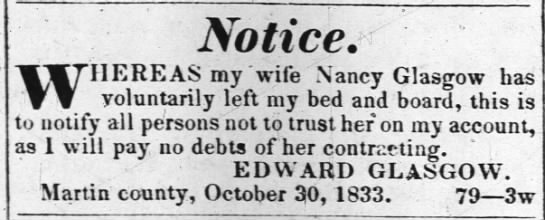
[The Windsor Herald and Bertie County Register 
(Windsor Bertie Co., NC) 22 Nov 1833]

Monday, September 5, 2016

Railroad to Roper?

             The grading on the road from Williamston (Martin County) to Plymouth (Washington County) has been completed and track laying is being done as rapidly as possible. All the trestles have not yet been built, but it is thought that the road will be finished and trains will be running on it before October. The terminus of this road will be at Roper City (Washington County), six or eight miles below Plymouth, where there is plenty of water front, and it is generally believed that a line of steamers will be put on from this point direct to Baltimore. It is thought that trains will be run direct from Weldon (Halifax County) to Plymouth and Roper City in connection with the steamers to Baltimore. It is also rumored that a road will be built from Roper City to some point on Pamlico Sound (Hyde, Dare, and Pamlico Counties).—Roanoke News
            The above paragraph from the News is right so far as it speaks of the Railroad being pushed forward to completion, but, it must be wrong when it says that the terminus will be at Roper City eight miles below Plymouth. In the first place there is no water front at said town. It being situated on McKensey creek, one of the most crooked streams we ever saw, and is not navigable only by small boats.
            The terminus of this road will undoubtedly be Plymouth as the company is now at work building the depot, elevators, etc. After the road is completed to this point, it may then run a branch road to Pungo river, unless Mr. Roper can be persuaded to connect his road to this place, which it is quite likely he will do.
            The R. R. R & L Company will run their road to Washington, making this the northern terminus. As to water front, no town can offer better.

[Roanoke Beacon (Plymouth, NC) 9 August 1889

Thursday, July 14, 2016

Smallpox in Williamston

       
     “The report of a case of smallpox has been confirmed. William Hoell, son of Alsala (?) Hoell, is said to have gone to New York and returned by sea. It is supposed he contracted the disease while in New York. The village has been thrown into great excitement. Several families have left and more will leave, perhaps in a day or two. Business is at a standstill. The school in the academy has come to a close two months sooner than planned, and the teacher, Mr. Matthews, his wife and son expect to leave this week for their home in Maine. The sick man, Hoell, has been carried about one and one-half miles from town to a school house near Samuel L. Whitley’s where he is to be attended to by a nurse, and no one else but the physicians is to visit him.”

[From the diary of Elder C. B. Hassell published in Martin County History, Vol. I, 
by Francis M. Manning and W. H. Booker, 1977]


Cushing Biggs Hassell was born in Martin County in 1809. His father died when he was 15. Prior to that time, he had attended school intermittently, but after his father’s death, he became the breadwinner for the rest of his family. He worked in Williamston, Halifax (Halifax Co.), and Plymouth (Washington Co.) and joined the Skewarkey Primitive Baptist Church near Williamston in 1828.

He went into partnership in a store with Henry Williams in Williamston in 1831 and later formed a partnership with Henry’s brother, William. He also became a deacon of the church in 1833. He was ordained in 1842, serving as pastor for Skewarkey and Spring Creek churches. In 1859, he became moderator of the Kehukee Association, the oldest Primitive Baptist association in America, and he served in that capacity until his death in 1880.

Mr. Hassell kept a series of diaries from 1840 until his death in 1880. These diaries are in the UNC library.

Skewarkey Primitive Baptist Church
By Ser Amantio di Nicolao (Own work) [CC BY-SA 3.0 (http://creativecommons.org/licenses/by-sa/3.0)],
via Wikimedia Commons

Tuesday, April 12, 2016

THE AIRSHIP VISITS WILLIAMSTON

__________

(Special to the [Wilmington] Messenger.)

            Williamson [Martin County]  N. C., April 14 [1897].—The mysterious airship seen at Wilmington and other points was observed here last night about 9 o’clock. When first noticed it appeared as a black mass against the moon-lit sky, going slowly from South to North. Its altitude was not great, being near enough to enable the observer to discern outlines of its rigging with the naked eye. As it passed over the town it ascended rapidly and a brilliant light was thrown out far ahead of it. The light was seen by some who could not, on account of the great height it had attained, catch the faintest glimpse of the aerial machine. If it should appear again there will be many to behold it as people are much interested and will watch for its re-appearance. — News and Observer (Raleigh, NC) 16 Apr 1897
_________

            The airship was first seen in North Carolina at Wilmington [New Hanover County] about April 5, 1897. The Semi-Weekly Messenger of that city reported that hundreds of people watched as the brilliant mass floated from east to west across the sky. “Many persons saw net-work about the aerial wonder.” Watchers with field glasses observed its wires, ropes and rigging and all were amazed by its powerful searchlight.
            The mysterious airship was next seen at Goldsboro [Wayne County] about April 9th or 10th. The Press-Visitor of Raleigh [Wake County] said: “Those who saw the object describe it as a great light moving rapidly from east to west.”
________

Found at http://www.angelfire.com/ma4/oddities/airship.html


            On April 13 The Press-Visitor in Raleigh carried the following article:

THE AIRSHIP.
_____

Arrangements Made for Its Appearance Tonight.

            The Press-Visitor this afternoon completed arrangements by which the air-ship will appear over Raleigh at 3 o’clock tomorrow morning.
            Efforts were made to secure its appearance here on a dark night, but the dates were all taken save tonight. This will prevent Raleigh, owing to the moon-light, from having quite as good a view as some other towns.
________

            Apparently the mysterious airship had an identity by this time. The Press-Visitor reported that many saw the airship pass over the city. It was identified as “the first automobile dirigible balloon ever invented which is a success. It is simple in its construction. It consists of an elliptical gasbag 128 feet in length and a car weighing 45 pounds. It is constructed on the aeroplane system, and operates perfectly. [This is 6 years before the Wright brothers first flew an ‘aeroplane’ over the sandy beach of NC.] The machine is operated by an electric storage battery and propeller. Its lifting power depends upon the number of cubic feet of gas in the bag."
            This announcement this did not stop the speculation. The airship continued to be spotted and by the time it was seen over Kenly [Johnston, Wilson Counties] about April 22, watchers saw sails and (very clearly) two men. 
            The Kenly sighting was the last reported in local newspapers throughout the months of April and May of 1897. The excitement had run its course.


Sunday, April 3, 2016

STATE NEWS
_______________

            The dome of the capitol has been painted white. [This probably means inside, as the roof of the dome is copper.]

This view of the Capitol's western facade dates to the 1880s. The picture is taken from
the website "Goodnight Raleigh," at http://goodnightraleigh.com/2015/08/raleigh-capitol-of-n-c/
           The Raleigh street car lines are being extended.
            A tribe of wild Indians is promised at Rocky Mount [Edgecombe County] Fair.
            In and around New Berne [Craven County] are forty manufacturers employing 500 hands.
            The political news from Nash is of a cheering character. It is believed that the entire Democratic ticket will receive majorities varying from 50 to 300.
            Track laying has begun on the Durham end of the Durham-Henderson [Vance County] railway—the Durham and Northern, as it is called. Some twenty miles of the Henderson end have been built.
            The laying of iron on the Scotland Neck [Halifax County] and Greenville [Pitt County] road has reached Goose Nest* [Martin County], about three miles from the Williamston [Martin County] and the trestles are nearly all finished. Contracts have been made for the grading of the road to Greenville and we learn that it is the intention of the Atlantic Coast Line to complete the road to the latter place at as early a date as possible. The distance is about twenty-three miles.
            Work on the Chowan and Southern road is progressing very rapidly. The contract for the bridge across Roanoke river has been made and work is now being done preparatory to building the piers. Great trees are being driven down in the bed of the river for foundations. One hundred mules have been taken down to Mr. Alexander’s farm near Palmyra [Halifax County] and will be used in building the embankment on this side of the river. A large number of hands is also employed. They have gone into camp and expect to remain in camp six months.

* A Union soldier on a raid gave Goose Nest its name. It became Conoho in 1891 and Oak City in 1905.


[Taken from The Advertiser, (Wilson, NC) 27 Sep 1888]

Friday, March 25, 2016

Among the Country High Schools

(Excerpts From Principals' Preliminary Reports for the Fall Term, 1913.)

BEAUFORT COUNTY

Principal A. W. Davenport, Pantego High School.
     Library and office room added. Betterment Association has made about $20.00 and bought six new stools, cost $50.00. Prospects are very bright for good year.

BERTIE COUNTY 

Principal J. B. Thorn, Jr., Aulander High School.
     $12,500 worth of bonds voted for a new building to be erected next year.
     Prizes offered for best piece of needle work and also handicraft. Two literary societies. School in a flourishing, prosperous condition

CRAVEN COUNTY

Principal, W. G. Gaston, Dover High School
     We need a dormitory very badly and we expect to have on in the near future. This is a find location for a High School. We have a large field to draw from. With little effort the attendance could be increased 50 per cent., I believe. We have had to turn down numbers, because we have no place for them. Our present capacity is reached. Our school has never been in better shape. There is no finer school community in North Carolina than Dover.


Dover High School, Craven County
Wikimedia Commons
https://commons.wikimedia.org/wiki/File:Rural_public_high_school,_Dover,_
Craven_County,_NC_(6797187875).jpg

EDGECOMBE

Principal L. L. Hargrave, Battleboro High School.
     Spelling, writing, drawing, nature work, and sight-singing are taught throughout school course. Twelve pupils take typewriting. Physical culture is given free to school.
     Three more recitation rooms have been added this fall, one of which is fitted up for science. Sixty-five dollars has been contributed for apparatus for science classes.
     Within two years the school has about doubled in pupils, has doubled in teachers, and has more than doubled in classrooms. We now have two flourishing literary societies. 

GRANVILLE COUNTY

Principal R. P. Crumpler, Knap of Reeds High School.
     We have a piano and a music department this year.

HALIFAX COUNTY

Principal John T. Cobb, Enfield High School.
     There exists the heartiest co-operation between the school and the community. The Betterment Association is an active factor here and does great good. The trustees have ordered the fourth year to be added to the high school course, making the school run as a four-year high school.

Consolidated School, Halifax County
Taken from Eastern North Carolina Where Prosperity is Perennial INVITES YOU! http://docsouth.unc.edu/nc/ncencyc/ncencyc.html

JOHNSTON COUNTY

Principal S. E. Leonard, Kenly High School.
     School has use of dormitory free. Superintendent rents out rooms, employs a matron and runs a regular boarding house. He either makes or loses as the funds are his and not the school's. Five of the teachers and a number of pupils live in dormitory.

MARTIN COUNTY

Principal W. H. Mizelle, Robersonville High School.
     Since the close of school the latter part of April of this year, our trustees have added to the school building one new room, enlarged two others, tinned the roof of the entire building, painted the walls and ceilings of two rooms, put in seven coal stoves, furnished nicely the one new room, and done considerable general repair work. They have also improved the school ground.

NASH COUNTY

Principal Arnold W. Byrd, Mt. Pleasant High School.
     The dormitory is managed by a matron assisted by the principal and the assistant teachers.
     A Betterment Association has been organized and is doing valuable service for the school. Through its efforts we have secured a school farm.

Principal H. A. Nanney, Red Oak High School.
     The dormitory and mess hall are managed by a matron. Board is given at club rates, or at actual cost. A room rent fee of 50 cents a month is charged each student.
     We will vote on $10,000 worth of bonds Dec. 5 for the erection of a new school building. We hope to establish a Farm Life School next year in connection with the school. (Bond issue carried Dec. 5.

Principal J. I. White, Whitakers High School.
     Organized two literary societies, one for each sex. Have an excellent reading room. Increased our library. A very live Betterment Association, which employs and pays a music teacher. Attendance good. The first month we did not have any tardies and only seven absentees. Only eleven tardies last month.
Consolidated School, Nash County
 Taken from Eastern North Carolina Where Prosperity is Perennial INVITES YOU!
 http://docsouth.unc.edu/nc/ncencyc/ncencyc.html

PERSON COUNTY

Mrs. J. A. Beam, Principal, Bethel Hill High School.
       We have had some work done on our building and have put in  some equipment, but we greatly need a dormitory. We could easily double our attendance if we had it.Several boarders are scattered through the neighborhood now.

Miss Allene Patton, Principal, Bushy Fork High School.
       The school building was painted during the summer.

WAKE COUNTY

Principal T. E. Story, Bay Leaf High School.
     The dormitory is run by Mr. H. P. Thompson, one of the trustees. The dormitory alone just cost $1,750, but the lot (4 1-2 Acres) and a storehouse that is on it all cost $2,750.

Principal M. B. Dry, Cary High School.
     Boys pay matron of boys dormitory $9.00 a month for table board, and they pay the school $1.50 for room rent. Girls pay $8.25 for table board and $1.75 a month for room rent in the girls’ dormitory.      We are putting up a new school building, which, together with the dormitories, will cost $33,000. The old school building will be converted into 40 rooms for dormitories for boys. We are now paying rent on the girls’ dormitory, but we are going to buy it and enlarge it so as to accommodate 60 or more girls.
     We have bored a 200-foot well on the campus which will furnish 20 or more gallons of water per minute.

WARREN COUNTY

Principal E. P. Dixon, Wise High School.
     We have a hotel here for dormitory, but we are not using it. We started to open it, but the county took the appropriation from us so we could not secure another high school teacher. We let it stop. The County Board promises to give us the appropriation this year. What will be done I do not know.

WILSON COUNTY

Principal C. O. Armstrong, Bock Ridge High School.
     We are now converting old school building into dormitory. A part of fund raised by private subscription, and for remainder an application was filed for a loan.

[Taken from The North Carolina High School Bulletin, Volume 5: edited by Nathan Wilson Walker. January 1, 1914: University of North Carolina]


Wednesday, March 2, 2016

Octagon Soap


            While living in old Dymond City, Griffins township, Martin County, about 1883, a Mrs. Elkington invented the world-famous “Octagon Soap.” Gaining her idea from some of the older women in the area, Mrs. Elkington made the soap for herself and a few friends. When she moved to Philadelphia, presumably in the late 1880s or early 1890s, she continued making the special soap for herself and neighbors, the latter finding it a remarkable soap.


Octagon Soap,
 Sales are increasing rapidly because:
First--It is a high grade soap, simply perfect, made from sweet, pure stock unadulterated, sure to please.
Second.--It is well advertised by the immense list of premiums for the old folks, young people, and children.
This soap box was found in an attic. The picture came from Dolly Sarrio's Blog at
hibiscushouse1.blogspot.com

          A Mr. Hanes was attracted by the merits of the soap and reportedly procured a patent, calling it “Octagon” on account of its shape. The formula was said to have been sold to Colgate-Palmolive-Peat. For many years the shape of the soap bar featured the advertisements of the manufacturer who pointed out it was easier to hold that the square shaped bars of “Old Monday,” and other contemporary brands.

[Taken from Martin County History, Volume I, by Francis M. Manning and W. H. Booker: 1977]

Thursday, February 25, 2016

Plea for Aid
Local Militia in Dire Straits

War of 1812


The following counties of the Detached Militia were called into service at Norfolk, Virginia by orders in September of 1814 - Bertie, Chatham, Edgecombe, Franklin, Gates, Granville, Halifax, Hertford, Johnston, Martin, Nash, Northampton, Orange, Person, Wake, and Warren. Those from Chatham, Orange, and Person were ordered to return to their respective homes before they arrived at Gates Court House, the place of rendezvous.

ADDRESS

To the citizens of the counties of Hertford, Bertie, Martin, Northampton, Halifax, Nash, Edgecombe, Johnston, Warren, Franklin, Granville and Wake, and to the patriotic citizens of North Carolina generally.

The undersigned take the liberty of addressing you in behalf of the volunteers and drafted militia, detached from the several counties above named for the service of the United States, and now stationed under your command at Norfolk. — It is known to you that these men were suddenly called from their homes, without being afforded an opportunity, and many of them not possessing the ability, to make the necessary preparations for a six months tour of duty at an unknown season. The United States do not furnish clothing to the militia in their service—most of your friends and neighbors, therefore, who have repaired hither, to the post of danger, are entirely destitute of the clothing necessary to protect them from the inclemencies of the approaching season. Already they have suffered much from the want of these conveniences which their situation required, and we take pride in saying they have born those sufferings with a cheerfulness, patience and constancy, highly honorable. It will be impossible for them, however, to withstand the rigor of the approaching season unless they are provided with blankets and comfortable woolen clothing.

The only means by which we believe the wants of these troops can be speedily and effectively supplied, is by the appeal which we now make to your benevolence, patriotism and humanity—an appeal which we are sure will not be made in vain. We cannot believe that your patriotism will suffer the brave men, who have marched with such alacrity to the post of danger, and who are willing to risk their lives in their country’s defense, to perish by the severities of the season for want of the common conveniences of life… when it can be so easily afforded—We seek voluntary contributions from you, therefore, either in woollen clothing and blankets, or in money, at your discretion. Let receivers be appointed in each county, and let them transmit, without delay, the amount received, together with the names of the generous donors, to one of the field officers, who will be responsible for its faithful distribution. You will thus enjoy the sweet reflection of having snatched from the grave many a suffering soldier, and of having performed your duty to your country, to your friends and neighbors, whose gratitude will follow you through life.

We are, with sentiments of the highest respect, Your obedient servants,

D. McDonald, Col. 1st Reg. NCDM
A. Joyner, Lieu. Col.
Jos. F. Dickinson, Major
John C. Green, do. (?)
James Iredell, Captain
John J. Inge, Captain
John Bell, Captain
Harry Bryan, Captain
John Green, Captain
Isaac Watkins, Captain
John L. (?) Laughter, captain
John F. (?) Walker, Captain
H. G. Williams, Captain\
Cantonned near Norfolk, 20 Oct 1814

[Political Synopsis, 17 Nov 1814, Tarborough and North Carolina – The War of 1812 website: http://www.carolana.com/NC/1800s/antebellum/war_of_1812_military_units.html]


Monday, November 5, 2012


July 4 Celebration In 1859


A patriotic spirit seemed to pervade the entire community. The arrival of the annual visitor was announced by the cannon’s deafening peal and the ringing of bells. Our hearts leaped with joy when we reflected we were fulfilling the prophecy of one of our revolutionary ancestors who said while urging his countrymen to declare their independence, “This day will be celebrated by our posterity with bonfires and illumination.”

The patriotic lines of Whittier’s …

“Go ring the bells and fire the guns
And fling the stormy banner out
Cry Freedom! Till our little ones
Shout back their tiny shout.”


 This 33-star Flag became the Official United States Flag on July 4th, 1859. A star was added for the admission of Oregon (February 14, 1859) and was to last for 2 years. http://www.usflag.org/the.33.star.flag.html


At half past ten a procession composed of the citizens, proceeded by martial music, marched to the courthouse. Elder C. B. Hassell offered up a fervent prayer in our behalf as a nation after which the marshal of the day, L. E. Satterwaite, Esq., introduced Theodore Hassell as the reader of the Mecklenburg Declaration.
Mr. Hassell performed his duty in a manner perfectly satisfactory to all.

Reading slowly and distinctly, Dr. Chas. W. Knight was next presented as the person selected to read the National Declaration.
Dr. Thos. C. Pugh arose and after an introduction proceeded to deliver the oration for the day. On taking his seat he was greeted with rounds of applause.

The exercises being over, a procession moved down to Main St. and then dismissed. At night a cotillion party was given at the old hotel.
The amusement was kept up until a late hour when the company, wearied from exertion, dispersed.

[This account is from the newspaper,  Democratic Banner, and describes the 1859 celebration at the Martin County Courthouse in Williamston. The article was first printed in the Tales Along The Roanoke by Louise R. Booker, Illustrated by Bailey Phelps, Edited by Deane R. Phelps: 1974.]


Tuesday, July 6, 2010

NEWS FLASH!!

Hanging Too Good.

Some scoundrel Monday tried to wreck the cars on the Hamilton railroad, and only the having to run an extra train to the Shiloh Oil Mills to carry cotton seed prevented a horrible and harrowing disaster.

It was not determined until after one o'clock to send this train so the dastardly deed was done in order that the train going to Hamilton leaving here at 5:30 should be wrecked.

The extra left the Princeville depot at 3 o'clock and ran off the track at the Y switch, the one next to the Lloyd farm where there is a deep ravine, the deepest on the road. At this point it is the custom of the engineer when carrying freight only to Shiloh to switch his engine on the Y, let the cars pass and then push them to the station.

When he reached the point he was therefore going slowly and to this is due the reason why the entire train was not thrown down the tressel [sic].

The switch target showed that the way was opened and the engineer ran along until he forced his engine off the track. Examination showed that the switch had been uncoupled so that the flanges of the engine and the car wheels would not switch the next rails.

It was a bad run off, for eleven hours elapsed before the train was on the track again. To take the passengers down another engine and cars had to be telegraphed for one from Hamilton.

[Tarboro Southerner, 1888. This story was published in The Connector, newsletter of the Tar River Connections Genealogical Society in the Spring 2000 issue.]

Thursday, April 15, 2010

A Hasty Wedding


Marriage Extraordinary.

Married, at Edgecombe House, in this place [Tarboro, Edgecombe Co., NC], on Sunday morning last, by J. T. Clark, Esq, Mr. James Groves to Miss Amanda Ward, daughter of Mr. Joseph Ward. The youthful pair, aged 18 and 15 years, left Hamilton, Martin county, [North Carolina], on Saturday night last, and after divers mishaps by mud and flood, (the course of true love never running smooth,) arrived here at 4 o'clock on Sunday morning—by 5 o'clock they obtained the requisite fixins and were married—remained here until 8 o'clock, and turning their faces homeward, went on their way rejoicing.

[Tarboro' Southerner, 9/16/1855]


The Rest of the Story
For the Southerner
—————


Hamilton, Sept. 10th, 1855


Mr. [George] Howard: Dear Sir, Having seen my marriage published in the papers, I will give you a small sketch of things that passed before we were married. If you see proper, you can have it added to what has been said.

I had been visiting her father's house and waiting on Amanda for the last six months, and was received as a neighbor or a friend by the old man and the rest of the home family; but her grandmother being offended with me, began to be quite suspicious thinking I was courting Amanda.

I was in the presence of both one night and Amanda and I conversed freely together until 9 o'clock; after I retired the old lady said to Amanda, you seem to treat Mr. Groves with great respect; she replied, yes, grandmother, I treat him with the great respect I have for him.

Yes, the old lady said, the first thing I know you and he will be married. You need not be surprised, was the reply.

It filled the old lady's heart with anger; she then resolved to break peace between us. She then done and said everything of evil against me that she could, but as true lovers it did not seem to avail anything, or to turn her at all; but her words were to me that the more she said, the better she loved me.

The old lady making a failure in that undertaking, she thought she would seek revenge some other way; she then goes to her father and her cousin Tiur, and said to them as follows: Groves is going to your house for the purpose of seeking the advantage of your daughter, and if I was in your place I would stop him from going there—and also slandered me every way she could.

Then the old man went home on Tuesday morning and said to Amanda, do you give Mr. Groves encouragement to come here? Father, If I was not here he would not come. Well, Amanda, I had rather see you laid in the grave than to marry him. Why father, what have you got against him? Don't you find him every time the same? Yes, said the old man, I have nothing against him, but I don't want you to marry. Well, father, you can stop him from coming here, but that will never turn me from him. Her father then left her, and said no more at present.

On Wednesday following the old Mother went to her father again telling him a great miraculous tale, such a one as I am not able to describe. Her father being much disturbed, he hastened home to talk to her again. Words were passed as follows: Amanda, it is reported all over town that you and Mr. Groves are going to marry; whether or no, what you intend shall never be, and if I ever catch him here again there will be blood spilt, as sure as there is another world.

It filled her heart with sorrow to hear him talk so about one she dearly loved. She then sat down to write a note to me, to let me know how words had passed about me. Her words were as follows: Mr. Groves, my true one, for you feel dearer to me than any one on earth; therefore I will write a few lines to you to let you know how words past about you and I today. He said if you did come here again there would be blood spilt as sure as there is another world. My true one, that will never turn me from you. If they take my life, oh! I can't, I can’t turn from one I love so dearly. I do love you and that you do know. I am willing to take the first share, I am willing to die for you; but my true love, will you turn from me? Will you ever?

I being present and in her father's house, I as a man that fear no man, I arose from my seat in her presence, and in the presence of the rest of her folks said, No, no, I will never—be ye faithful unto me and I will to you—though I am a little man, I am not afraid of any man; for we are contending for that which has been deemed honorable from the foundation of the world, and if God is for us who can be against us—and we shall come out more than conquerors at last. We then departed. She said with a trembling voice, do not forget me. My answer was, I never will.

Arrangements I then made, and Saturday night at 10 o'clock I went to her residing place, took her and started to Tarboro', and there was married. Her people knew nothing of it until next morning. Correct errors, and mistakes. Ages 18 and 23.

James D. Groves.
Amanda W. Ward as were.


[Tarboro Southerner, 10/22/1855. The Connector, newsletter of Tar River Connections Genealogical Society, Winter 2007 issue.]


Note: J. D. Groves, 18, and Amanda, 22, were listed on the 1860 Census in Hamilton, Martin Co., NC. They had 2 children: Jenigan, female aged 3 and Thadis, male aged 1. Groves was a merchant with real estate valued at $1,250 and a personal estate of $4,300. They were census record 1010.

Groves's father-in-law, J. J. Ward, was record 1016, so they apparently lived near each other. Ward was a farmer with real estate valued at $9,500 and a personal estate o $1,200. He had 5 people, aged 10 and younger, living in his household. The oldest female was 16, so perhaps he had needed Amanda as his housekeeper in 1855.

Thursday, February 11, 2010

Jolt and Wiggle


Jamesville and Washington Railroad


Facetiously known as the "Jolt and Wiggle" or "Jolter and Wiggler" because of its bumpy ride, the Jamesville and Washington Railroad (J&W) and Lumber Co. was incorporated in 1869. When it was completed in 1885, it linked Washington (Beaufort Co., NC) on the Tar-Pamlico River and Jamesville (Martin Co., NC) on the Roanoke River, a distance of about 20 miles. The J&W was the first railroad to be built in Washington.

Built to haul lumber from Diamond City near Jamesville to the port at Washington, the small wood-burning engine, topped by a large triangular smoke stack, is said to have spent as much time off the track as on. In 1879, an Edgecombe paper wrote, "The Jamesville and Washington [Railroad] is having wrecks while the Williamston and Tarboro [Railroad] is still being argued about." In fact, no train ever ran from Williamston in Martin County to Tarboro in Edgecombe County.

After the Civil War, Jamesville made a comeback, largely due to the J&W. By 1870, the narrow gauge railroad was serving a large-scale timbering operation around the town. In 1889, Daniel Simmons' rejuvenated operation boasted of being the largest maker of wood shingles in the state, thanks in large part to the "Jolt and Wiggle."

Diamond City grew up around the logging camp and flourished for about 25 years before fading away.


This is a picture of a car and, behind it, an engine of the Jamesville and Washington Railroad. The picture was taken from the East Carolina University digital library. It is part of the Capt. Henry C. Bridgers Collection, Joyner Library, East Carolina University. [http://digital.lib.ecu.edu/943]. It was dated Dec. 23, 1888.


In 1892, the J&W was sued by a customer of the railroad who was not named. According to the suit, the plaintiff, a citizen of Washington, NC, wanting to go to Edenton—which had no railroad— purchased a ticket (for $1) to travel to Jamesville on Sept. 7 and return to Washington on Sept. 9. The Plaintiff road the "Jolt and Wiggle" to Jamesville on the 7th and he went on to Edenton.

It so happened that on the 8th of September, soon after leaving Jamesville for Washington, the axle of the J&W's engine broke. When the plaintiff returned from Edenton to Jamesville on the 9th the railroad was unable to carry him on its road from Jamesville back to Washington, "as it had contracted to do." Therefore the passenger was suing the railroad for damages which he claimed were $500.

The allegation was that the railroad's " roadbed was in a bad, shackly, and ruinous condition; that defendant had but two engines, both of which were worn and in bad condition, one of them at that time being in the shops for repair, and not in a condition to be used; that the bad condition of defendant's roadbed had rattled the other one so as to cause the axle to break." The passenger claimed that this showed willful negligence by the railroad.

Of course the railroad denied the claim of negligence while admitting that the road was not in good condition. Further, the railroad claimed that "it was poor and struggling for existence, and that it was expending the whole earnings of the road, and more, in trying to keep it in good repair, and was not able to do so

The plaintiff did not received the $500 he sued for.

See http://www.pwrr.org/nstation/jamesville.html for a picture of the Jamesville depot.

Sources:
Washington, North Carolina By Louis Van Camp: 2000
Annual report of the Board of Railroad Commissioners of North ..., Volume 2
The Connector, Newsletter of The Tar River Connections Genealogical Society, Spring 2003
http://www.visitmartincounty.com/ThingsToDo/CH_Jamesville.asp