Showing posts with label Edgecombe County. Show all posts

Thursday, June 18, 2020

Burning of the Steamer Greenville.

(Cor. of The News and Observer.)

     WASHINGTON, N.C., September 17, 1880.
     An alarm of fire was given at 8 o'clock this morning and the entire fire department turned out promptly. The steamer Greenville was found to be in flames, and although two streams of water were soon playing upon her, the fire gained headway for several minutes. The hurricane deck, various saloons, pilot house, engine rooms, &c., were composed of inflammable material, so that the flames shot with fearful rapidity from one part to another until all the woodwork above the lower deck was destroyed. The hull was saved almost intact and the boiler and engine are not materially injured. The loss is estimated at from $2,000 to $2,500. Current report at this instant says she is insured for $5,000. I can get no reliable information on this point, her owner being absent. The steamer Greenville is owned by Capt. A. W. Styron and runs from this point to Tarboro (Edgecombe County) in connection with the Northern Clyde line.
Steamship Greenville
Core Sound Waterfowl Museum & Heritage Center in Morehead City, NC
https://www.coresound.com/history
     The fire is supposed to have originated by the explosion of a kerosene lamp in one of the saloons. No other loss occurred, although several warehouses were in imminent danger.

[News & Observer (Raleigh, NC) 19 Sept 1889]

Thursday, March 19, 2020

     General Jeremiah Slade was born in 1775 in Martin County, NC. He served in the state House of Commons from 1797 to 1800 and as a state senator from 1809 to 1815. He was a Brigadier General in the War of 1812. He commanded the Fifth Brigade of the Seventh NC Division of Militia which included recruits from Martin, Edgecombe, Halifax and Northampton Counties. Slade died in 1824.
    Beginning on June 27th, 1819, Gen. Slade traveled from Martin County, NC to Nashville, TN. His daily diary of the trip seems to present a curmudgeon who found fault with many things along the way. We will not go all the way with him, but will follow him until he reaches the University in Chapel Hill.
27th.
 Dined at John Griffin's, stopped at Wilson Sherrod's, fed and rested my horse, bill 25cs., and arrived at Tarboro [Edgecombe County] that evening.
28th. 
After arranging some private business and visiting my friends with whom I had some agreeable conversation on the subject of my journey, set out about 10 o'clock, bill Mrs. Gregory $1.50, McWilliam $1.20. By 121/2 arrived at Mr. W. Parker's to dinner, spent about 2 hours in very agreeable conversation with him and his amiable lady; bill 50cs. Set out at 3 o'clock, stopped at Daniels a few minutes to have my horse watered and get some grog, went on, met very unexpectedly an old acquaintance, Mr, James Blount, from Georgia. After usual ceremonies went on and arrived at sundown at the well known stand in Nash County, Mr. J. T's, where I put up the night. Went to bed supperless. Saw there all the features of uncivilized life and that Mr. T 's daughters though unmarried all had separate names, as Polly H , Ann B &c. 
29th.
Set off from T 's before sunrise. Bill 50cs. Memo. a lame man with a blind horse staid last night at T's who had been eight days traveling from Raleigh there, only thirty-five miles. Arrived at Major Alford's to Breakfast, where I met with every attention, and treated very hospitably. Bill 50cs. Arrived at Raleigh [Wake County] at 12 o'clock, at Col. Cooke's. After dinner having dressed strolled out to stroll up and down the principal streets without appearing to notice one of the puffed little great men of the city, being resolved to observe as little ceremony towards them as they are usually in the habit of showing to all strangers, and after visiting my cousins at Mrs. Pullum's, conversing with them for a while, I returned to my lodgings. In course of the day had occasion to call on the deputy clerk of the Federal court on business, was ushered into his office with all the hauteur of a French exciseman, and treated with every mark of supercilious pride and haughty arrogance and finally dismissed with contempt. After supper I retired  to my room where I was visited by J. B. Slade, my relation, who staid with me all night & we pass the time much more agreeable than I had done during the day. 
30th. 
Left Raleigh at Sunrise, Bill $2.00 with a perfect confirmation of former opinion "that the citizens are a perfeet set of blood suckers who prey upon the vitals of the State and wallow in luxuriant indolence." Arrive at Jones' to brkft, ; bill (60cs. Arrived at Chapell that evening in a severe shower of Rain ( which tho' not so agreeable to my situation was most acceptable to visitors to that part of the country, as it was and had been for some time so dry as to endanger the crops of corn in all the upper country. Wheat crops uncommonly good, price 25cs per bus. & and little or no demand for it at that or even any price). At Mrs. Mitchell's Hotel was met and greeted as soon as arrived by cousin Jeremiah and Thomas B. Slade, dined, after the shower was over went with Cousin Thomas to Mr. Mooring's Hotel, was introduced to several collegiates of respectability & to Mr. Mark Henderson, attorney at law, whom I found particularly agreeable, polite and attentive, & as we returned to Mr. Mitchell's invited us to his father's, Pleasant Henderson's Esqr. to sup & spend the evening, which we accepted, (Cousin Thomas from an inclination to be with the young ladies of the family & I for the gratification of an acquaintance of so respectable a family). On entering the house I was introduced by Cousin Thomas to a Miss Kittrell & to Miss Eliza Henderson, only daughter of Mr. P. H., who, take her all in all (tho' not a Venus di Medici in form & feature) is as pretty, agreeable, and desirable as is rarely to be met with. She was easy in her manners, gracefull in her actions & movements, condescending and affable in conversation, still modest and unassuming. We spent the evening till late bed-time in very agreeable conversation, when we retired to Mrs. Mitchell's & rested for the night.
[As that appeared in The Raleigh Minerva (Raleigh, NC) 2 Jul 1819. This was about the time that Jeremiah Slade passed through.]
Thursday, July 1st.
After breakft. visited college which appeared almost deserted, except now and then a solitary Bachelor silently gliding across the long passages. The Dialectic Hall appeared much improved since my last visit, the library has received a large acquisition of books to the amt. of five hundred dollars within the last year. Met there Mr. Thomas Green, ov Va., late of the senr. class. He appeared very much reserved, and tho' we had been formerly acquainted he seemed not disposed to renew it. Returned to Mrs. Mitchell's to dinner and shortly after set out for Hillsboro, accompanied by Cousin Thos. Bill with Mrs. Mitchell $2.00. We arrived at Thompson's Inn in Hillsboro at sunset, disappointed in our expectations of meeting Mrs. Doctr. Pugh & others on their way to Louisiana, nor did they arrive during my stay in Hillsboro.
2nd.
Lef Hillsboro after Breakft, Bill $1.80. Crossed Troliner's Bridge about 12 o'clock: had a smart words with Mrs. Troliner about the toll, paid 20 cs and parted in friendship.

["Slade Genealogy" at  http://www.sladegenealogy.net/g0/p353.htm ;

Monday, March 16, 2020

TERRIBLE RAIL ROAD ACCIDENT
Remarkable escape.
________

     By a dispatch received here on Monday, we learned of a terrible accident on the Wilmington & Weldon Rail Road near Whitaker's Station (Nash, Edgecombe Counties).
     By our exchanges, we learn the following facts.
     While proceeding along on schedule time, and when just over an embankment some twenty feet high, the engineer observed that a rail was misplaced on the track. He immediately blew his whistle and shut down the engine, but could not check its speed sufficiently to prevent thee accident. The engine and tender, second and third class cars, and ladies' coach all were tumbled down the embankment and literally smashed. The sleeping car alone remained on the track, and to this the ladies' coach was held by the coupling pins and greater damage prevented. The engine was turned wheels in the air, and is seriously damaged. The engineer, Mr. John Hewett,
escaped without injury, how it is unknown. Captain Geo. Morrison, the Conductor, was in the second class car, and also escaped unhurt. The passengers and train hands also escaped as by a miracle, no serious injury having been sustained by anyone. On the whole, the escape of all on board is the most miraculous thing on record.

[Whitakers, NC Train Station 1966
Piedmont and Western Railroad Club
http://www.pwrr.org/nstation/whittakers.html ]
     To Capt. Morrison, the passengers unite in ascribing great credit for his attention to them during the whole affair,—he speaks in high terms of the assistance rendered him by his engineer and the sleeping car conductor.

[The Tarborough Southerner (Tarboro, NC) 4 Jun 1868]

Tuesday, March 3, 2020

NEAR BEER
A Real Problem
____________________

            From the earliest days of our history, there have been temperance movements attempting to ban the production and use of alcoholic beverages — with varying degrees of success. Finally, in 1920, the 18th amendment made the production, transport, and sale of intoxicating liquors illegal. The temperance fight led to many incidents that we might find curious today. "Near beer" was supposed to have only a very small percentage of alcohol, but it didn't always work out! Below are a few examples of North Carolina's battle against “near beer.”

[Raleigh Times (Raleigh, NC) 12 Jun 1905]

***************
Supreme Court Case
Is Licence Requirement to Sell Near Beer Legal?
____________________


     In 1909, the North Carolina Supreme Court heard a case challenging the right of Charlotte [Mecklenburg County] to require a $1,000 annual licence for the sale of near beer. Attorney general Thomas Bicket argued the case for the state, and he described near beer the starkest of terms.
  "What is near beer? The testimony in this case shows that it is a beverage that finds ready sale as a substitute for real beer. Our bibulous* constituents cry for it as children cry for Castoria**. It is made by the people who make beer, and drunk by the people who drink beer. It looks like beer, smells like beer, tastes like beer. … It is shoved across the old oaken counter, and the mirrored back bar, with the pictures of Aphrodite … springing from the foam, making the illusion complete. And sometimes in the gloaming the alchemy of a shadow projected from a policeman's expansive back and falling athwart the bar, works a transformation and suddenly, even as the thirsty one lifts the cup to his lips, near beer becomes the real thing.
     "And yet this court is asked to relegate this lusty beverage, this scion of centuries of vats, to the insipid level of soda water. Perish the thought! It proclaims itself in North Carolina as sole heir to and successor to the gaudy fluid. It boasts of its bubble, and sparkle and snap. It says to the disconsolate legions in an arid land, 'I may not be entirely wicked — but try me.' It capitalizes its kinship with Budweiser and Schlittz. It scorns soda water as Roosevelt scorns a mollycoddle, and lords it over grape juice like a mint julep over a milk shake."
     The state won the case and the lic
ence was enforced.
      
* excessively fond of drinking alcohol
** a laxative
[Taken from News and Observer (Raleigh, NC) 17 Nov 1909]


The Charlotte Observer (Charlotte, NC) 11 Aug 1888

***************

Sells Near Beer on the Water.
____________________

     Deputy Marshall Wilcox returned from a business trip to Currituck county Tuesday night. While on the trip Mr. Wilcox discovered a floating near beer joint down in Currituck which presumable pays no state of county tax.
     The proprietor of this establishment has secured a house boat and located at a convenient point, and he was doing a good business.

[Taken from The Advance (Elizabeth City, NC) 23 Jun 1911]
[The News & Observer (Raleigh, NC) 28 Oct 1899]

***************
FIFTY-THREE DRUNKS
______________________
Were Arrested By the Police During
the Month of February—
Banishment of Near-Beer Saloons May
Result in Decrease of Drunkenness.
______________________

[Taken from The Wilmington Dispatch (Wilmington, NC) 1 Mar 1911]
______________________

BEER SALOONS ARE NOW ALL CLOSED
______________________


       The Board of Aldermen of Elizabeth City (Pasquotank County) passed an ordinance in April 1910 regulating the sale of near beer. It stipulated that dealers who sold near beer must pay the Trustees of the Graded School of Elizabeth City $500 to be used for educational purposes.
     In addition, stores selling the beverage were required to open on Matthews stgreet east of Martin and Poindexter street and north of Matthews. The beer had to be sold within ten feet of the front door and all screens, curtains and other obstructions had to be removed from windows and doors.

     It was believed that this ordinance would put near beer saloons out of business. It was noted that "a few days ago, the near beer saloons… were running wide open and they were thriving too."

[Taken from Tar Heel (Elizabeth City, North Carolina) 15 Apr 1910]
[Raleigh Times (Raleigh, NC) 21 Jun 1899]
______________________

Rocky Mount Closes Near Beer Saloons.

     Rocky Mount, June 4.— Every near beer saloon and firm selling near beer and like beverages was closed yesterday and for the first time in years a resident in Rocky Mount cannot get the real stuff, or the near article. All near beer applications were filed before the city aldermen last night, and it was this body that denied the privilege of selling, and this morning the proprietors of the four establishments were met at the door by an officer who informed them that they could not open, as the city had denied them license. 

     The problem was that in the four saloons, beverage was being sold that was making many offenders drunk. The proprietors were ordered to sample all their stock and send it off for analysis. State law said that over thee percent makes "near beer" into the real article, and it was found that every man in the business was selling the near article that contained at least three and a half and even up to five percent alcohol.

[Taken from The Daily Times (Wilson, NC) 7 Jun 1910]
[News & Observer (Raleigh, NC) 7 Oct 1900]


Sunday, March 1, 2020

ICE CREAM.


     My Ice Cream business has grown so that I have been compelled to materially increase the facilities for manufacturing, after a careful study of the Ice Cream business. A life time experience coupled with a special attention given to Ice Cream making I can safely assert that I am making as good cream as can be obtained any where.
GOLD HILL DAIRY
Milk is supplied me in quantities from which I personally skin the cream. The fruits and other materials that enter into the composition of my Ice Cream are personally prepared and of the best obtainable. I can deliver Ice Cream at your home in packers especially made for the purpose on reasonably short notice, at prices as reasonable as possible consistent with the quality of Cream I use and service given.
Prices for Standard Cream:
Vanilla, Lemon, Orange, Chocolate.
In cans $1.50 per gallon
In cans $ .80 per ½ Gal.
In cans $ .40 per quart
In paper cartons per quart 75 ¢
In paper cartons " pint 40 ¢
In paper cartons " ½ pint 25 ¢

J. G. M. Cordon,
Tarboro, N. C.

The ice cream cone was first introduced at the St. Louis World Fair in 1904.
This Day in History - April 30 , 1904
http://www.todayifoundout.com/index.php/2015/04/this-day-in-history-april-30-the-cone-of-cones/


Sunday, November 17, 2019

S. K. Fountain—Renaissance Man


     The term "Renaissance Man" refers to a person with genius in many areas or a person who does many different things very well. Spencer K. (S. K.) Fountain surely qualified as a "Renaissance Man."
     S. K. earned his bread and butter working for the railroad. He began, at the age of 17, as a telegraph operator for the Wilmington and Weldon Railroad, later the Atlantic Coastline Railroad. In 1871, he became the passenger and freight agent in charge of the freight, ticket office and shops. He continued that service for the rest of his 54 years with the railroad. He was also credited with being the prime force behind getting the Emerson Railroad Shops brought to Rocky Mount. The railroad yard was a major source of jobs and revenue for the area for many years.
This is a picture of an engine being repaired at Emerson Shops about 1928.
The picture is from Worthpoint:
https://www.worthpoint.com/worthopedia/atlantic-coast-line-acl-emerson-shops-1622372470
     S. K. learned telegraphy in 1867. Fountain was involved in the construction of the telegraph line from Tarboro [Edgecombe Co.] to Washington, [Beaufort Co.] NC that was completed in 1881. The first message over the line was reprinted in the Tarborough Southerner: "To Dossey Battle [Editor]: We send greetings. Washington is successfully connected by telegraph." The message was dated April 27, 1881, and signed by S. K. Fountain. He and his brother, Joe Fountain, an ACL Superintendent at Wilmington [New Hanover Co.], NC, supervised the installation of the first telegraph line from Rocky Mount to Wilmington.
     In 1880, Fountain, while continuing his work with the railroad, opened Rocky Mount Iron Works, Rocky Mount's first foundry and machine works. This business was located on East Main Street between Marigold and Hill Streets in Rocky Mount [Edgecombe Co.]. It was probably the knowledge gained at this business that enabled him to be so successful in some of his other ventures.
     S.K. is credited with bringing the telephone to Rocky Mount. Between 1885 and 1890, Fountain and his sons, Will and Wyatt, strung a single span of wire from the freight depot to the Rocky Mount Mills. They hung the line on trees or poles along the railroad right-of-way of the spur track to the mill. For insulators, S.K. cut off tops of soft drink bottles, hung them on nails and strung the wire across them. Fountain devised flaked carbon and cotton against a thin metal diaphragm for transmitter and earphone. 
     A turn of the crank signaled the other end of the line. He did this to establish voice communication between the railroad station and its most important client, the Rocky Mount Mills. He installed bells to alert the other end of an incoming call, and the signal was cut off by placing the receiver in a cradle. He was able to alert mill operators of arriving freight and get their requirements for freight cars for loading.
     This initial effort caused S.K. to use his Rocky Mount Iron Works, which was originally intended for farm machinery, castings, and steam engine repairs, to produce telephone equipment. He found few sources of supply for the necessary magnetos and coils, so he designed and made the castings himself and went into their manufacture. 
     Telephone Exchange
     The Rocky Mount telephone exchange had its beginnings in the S.K. Fountain home on S. Church St. It was operated by members of the Fountain household. By the late 1880s his telephone system had grown until he had a total of 20 subscribers in a thriving town of 500 souls. The exchange was later located upstairs in the Vaughan Building, later Epstein's Ladies Shop on NE Main St.
     The local telephone exchange kept pace with the growth of the city. There was a telephone in the Bank of Rocky Mount, between the Municipal Building and No. 1 Fire Station on NE Main Street. In 1895, S.K. enlisted the aid of Dr. W. P. Mercer and established telephone service between Rocky Mount and Tarboro. From the exchange at Dr. Mercer's home at Temperance Hall in Edgecombe Co., he also connected with a phone circuit to Wilson, NC.
     As the demand for service continued to grow, S.K. began manufacturing his own telephones. He organized a telephone manufacturing business located on Main and Washington Streets in the block south of Hill St. In 1890 Rocky Mount's first Chamber of Commerce boasted "telephone manufacturing" among its businesses. He also continued manufacturing and testing materials at Rocky Mount Iron Works, which occupied most of the block bounded by S. Main, Hill and Marigold Streets and extended across what is now Washington Street.
     Fountain continued to manage the telephone exchange business for years. He eventually sold the exchange to the Henderson Telephone Exchange when 1,200 phones drew too heavily upon his time from the railroad. Later this company merged with the Carolina Telephone and Telegraph Co.
A Horseless Carriage
     Typical of a Renaissance Man, Fountain was also interested in transportation. He built a "horseless carriage" by mounting a gasoline engine on a wooden frame with McCormick mowing machine wheels. However, he had problems with control. When he cranked up on S. Franklin St. and got it to full power, it became unmanageable and tore down his son-in-law's garden fence before he could get the engine stopped. He was undaunted however, and soon had his gasoline engine driving a railroad handcar. He toured much of the neighboring railroad sections on it. Three or four could be seated across the front and were protected by a big shade umbrella.
     Around the turn of the century, S.K. brought the first motorcar to Rocky Mount. It was a Reo runabout. The engine was located under the single seat and it was cranked from the side to start it.

This is a 1905 Reo Runabout, later than the one owned by Fountain. This is an ad card rather than a postcard.
The image is from from ebay:
https://picclick.com/1905-REO-Runabout-Motor-Car-Automobile-Vintage-372676346868.html
     A second car, a touring car, was purchased in 1904 from Dr. Stuart McGuire of Richmond, VA. This machine was painted red and was commonly called the "Red Devil." It had gaslights and much shining brass, with the direction controlled by a steering wheel. It created a stir in town and frightened the horses. Unfortunately, it ran over the dog owned by F.S. Spruill, Sr., the division counsel of the railroad.
     There are other "firsts" attributed to S.K. His home was the first in Rocky Mount to be lighted by electricity. He also had the first gas in his home. He had the first talking machine and made his own records from wax discs. He also experimented with radios and built one of his own. He owned the first bicycle here— a model with a tall forward wheel and small rear wheel. On an old business card, dated July 4, 1892, was printed: S.K. Fountain, Dealer in Ice. In 1904, he was chairman of the first meeting to discuss the establishment of a YMCA in Rocky Mount. The plan matured in 1911.
And Musical, Too
     As if his talents in all these other areas were not sufficient, S.K. was also the leader of an early Rocky Mount band—the "Silver Coronet Band." He played the violin for amusement.
     When he saw crowds gather each year for a riding tournament at Old Sparta in Edgecombe Co, Fountain reasoned that here was the making of an agricultural fair for Rocky Mount. Through his initiative and effort, the fair was held and brought the single biggest crowd of the year to the city.
     When Fountain reached the age of 70 in 1921, he retired from the railroad. He applied to Harry Walters, Chairman of the ACL Board of Directors, and who had been a contemporary friend of his, to permit him to continue to work. He was physically able to work, he wrote, and he further advised Walters that his pension was not sufficient to sustain him. It was not until Mr. Walters had assured him that he, too, would step down in a brief time, that S.K. became satisfied. Walters told him he could do nothing to increase the pension, but he enclosed a check for $10,000 as a gift of appreciation for his long service and faithful and fruitful work.
Who Was S.K. Fountain?
     Spencer K. Fountain was born at Buckhorn, in Wilson Co., NC on 26 Dec 1848 to Carolina Virginia Adams and Spencer Fountain. His mother was the daughter of Mary James Hobbs and George Washington Adams. S.K. Fountain married Sarah (Sallie) Louise Vaughan, b. 18 Dec 1852, on 22 Dec 1879. She was from Halifax County, NC. They had nine children.
[This article first appeared in The Connector, newsletter of the Tar River Connections Genealogical Society. Sources for that article were: Article by Hazel Rawls Carr, S.K. Fountains great grand daughter; "S.K. Fountain Was a Man of Many Firsts," by Pattie Lambert; "Fountain Switchboard on Display … " by Jim Nichols, Evening Telegram, 17 Nov 1974; "When the Railroad Came to Town," Evening Telegram, 29 Aug 1995.]

Tuesday, January 1, 2019


A Famous Visitor
Marquis de Lafayette

            Marquis de Lafayette, a 19 year old Frenchman, eagerly offered his service, at his own expense, to fight in the war for American Independence. Although discouraged by Benjamin Franklin, our minister to France, Lafayette bought the ocean-going Victoire and left France on March 27, 1777. The young man fought courageously for the Americans and Washington Irvin wrote about him: “Lafayette from the first attached himself to Washington with an affectionate reverence… it is a picture well worth being hung up in history—this enduring alliance of the calm, dignified, Washington, mature in years and wisdom and the young, buoyant, enthusiastic Lafayette.”[1]    
            He was wounded at Brandywine, but after a short period of time, he was able to accept the command of a division of Virginia light infantry. It was a time of brave men, swords, muskets, horses and intense suffering. Lafayette is best remembered, along with Gen. “Mad Anthony” Wayne and the Comte de Rochambeau, for defeating Cornwallis at Yorktown. The heroic young Frenchman played a noble part in our fight for independence.
Triumphant Return
            In 1824, Lafayette returned to America to make a triumphant tour which included several stops in North Carolina. Much loved by the American people, he was met by thousands of people wherever he went. He was accompanied by his son George Washington Lafayette and Auguste Levasseur, his personal secretary.
            In planning Lafayette’s journey through North Carolina, the sad state of the roads between Richmond and Raleigh forced the party to travel east through Suffolk, VA and Halifax, (Halifax County) NC. His first stop in NC was in Murfreesboro (Hertford County) where he spent the night of February 26, 1825 at the Indian Queen Inn. The difficult journey to Murfreesboro was recorded by Levasseur in Lafayette in America in 1824 and 1825: Or, Journal of a Voyage to the United States.
            “After stopping a few moments among the citizens of Suffolk, we continued on our route to Murfreesborough, where we were to lodge. Our late arrival had the appearance of a nocturnal journey. The bad condition and length of the road had tired our horses, and we thought for a while that we should be compelled to sleep at the foot of the hill on which the town is built. An enormous bonfire, lighted on a neighbouring mountain, whose light displayed our distressed situation; the illuminations of Murfreesborough, which exhibited the appearance of a city in flames; the noise of cannon resounding on our right, with the effect of battery on our flank; the cries of our escort; the whipping and swearing of our drivers, all was insufficient to stimulate our horses, which, sunk in the mud to their knees, appeared to have taken root, refusing to make the least exertion to draw us out of this sad situation, in which we remained about an hour. At length we arrived, and were very amply compensated by the cordial hospitality of the inhabitants of Murfreesborough, who neglected nothing to prove to General Lafayette that the citizens of North Carolina were not less sincerely attached to him than those of the other states.”[2]
North Carolina Highway Historical Marker Program- Murfreesboro, Nc
http://www.ncmarkers.com/Markers.aspx?MarkerId=A-65

Halifax
            Lafayette was escorted from Murfreesboro to Northampton Courthouse at what is now Jackson, (Northampton County) NC and from there to Halifax. They crossed the Roanoke River by ferry and arrived in Halifax at about 5 pm on February 27 amid the firing of artillery and ringing bells. “The mounted escort, consisting of 24 of our citizens …, paraded to receive the General, and proceeded to the river accompanied by the deputation of the corporation and county of Halifax. … The citizens and members of the [Royal White Hart] Lodge were formed in front of the hotel … and a numerous collection of ladies occupied the piazza …. On the arrival of the General in front of the Hotel, he descended from the carriage, was introduced to the persons composing the deputation individually and was conducted through the line to the piazza of the Hotel. The waving of Handkerchiefs by the ladies, the Masonic salutation, the respectful raising of the hat by the citizens, and the universal murmur which ran through the assembly, ‘Welcome Lafayette,’ evinced the deep sensibility which his presence inspired.”[3]
            In Halifax, impressive plans were made for the reception of General Lafayette, including a dinner and a grand ball. The banquet was highlighted by 13 toasts, one for each state. This was followed by the ball after which the visitor spent the night at Eagle’s Tavern.
Eagle's Tavern
Small Town North Carolina
http://www.smalltownnc.com/2013/09/07/historic-halifax/historichalifax_27/

           The next day the party made a stop at the Grove Plantation to spend an hour with Mrs. Willie (Wylie) Jones and her daughter. 


Documenting the American South: Memoirs of a Southern Woman "Within the Lines,"  by Mary Polk Branch, Page 94
https://docsouth.unc.edu/fpn/branch/ill14.html
Rocky Mount   
        They then continued to the village of Rocky Mount at the Falls of the Tar River where they were entertained at Donaldson’s Tavern. The Battle-Evans Mill, built in 1818, stood on the north side of the river in Edgecombe County. The town, south of the river, was in Nash County.
            People from both counties were crowded in a nearby grove hoping to get a glimpse of the Revolutionary hero. A number of people waited in their buggies or wagons. At last, a shout, “He’s here!” and the genial Donaldson came out of the tavern with the postmaster and others who were invited to a banquet hosted by the tavern-keeper. No list of the guest has survived. They spent the night at the tavern.
Donaldson's Tavern Marker located in Battle Park, Rocky Mount, NC
Marquis de La Fayette - Memory Spaces
http//marquisdelafayette-memoryspaces.org/north-carlina-nc/


Raleigh
           They arrived in the Capital at about 12 o’clock on Wednesday. “They were met a few miles from this place by the well disciplined corps of Cavalry under the command of Col. Thomas Polk of Mecklenburg. The General and suite alighted from their carriages, and were introduced to the company individually, after which, preceded by the Calvary and followed by nearly an hundred citizens on horseback, … they proceeded to this city [Raleigh]. At the limits thereof, they were met by the handsome company of Light Infantry… which received them with military honors. Here the General again alighted, and was presented to each member of the company—the interest of which scene was heightened by fine martial music from an excellent band.”[4] 

 An Incident

           In his journal, Levasseur noted the following incident: “The morning of our arrival at Raleigh was near being marked by a very unfortunate accident. In one of the calashes [a light small-wheeled 4-passenger carriage with a folding top] which followed us, was General Daniel of the militia, and a young officer of his staff; their horses ran off, and, the driver not being able to guide them, dashed violently against the trunk of a tree. The force of the shock threw both the riders and the coachman to some distance, but the one most hurt was poor General Daniel, who lay almost senseless upon the spot.
            “Our progress was immediately suspended, and General Lafayette, who, at the time, was a considerable distance in advance of the procession, hastily returned to assure himself of the nature of the accident. General Daniel already began to recover, when the hasty zeal of his friend, General Williams, was upon the point of placing him in greater danger than arose from the fall. This gentleman insisted upon his being immediately bled, and already held the fatal lancet in hand to proceed with the operation, when Mr. George Lafayette besought him seriously to forbear, representing that we had just left the table, and that a bleeding immediately after dinner might be attended with injurious consequences.
            “After having rendered General Daniel the first attentions which his situation demanded, we had him carried to the house of a rich planter, whom we had visited in the morning, some miles off; and, the next day, our wounded friend joined us at Raleigh, entirely recovered from his fall, returning his warmest thanks to Mr. George Lafayette, for having averted the employment of the lancet.                      “I was, at first, much surprised to see this lancet drawn upon such an occasion, but one of our travelling companions informed me, that in the southern and western states, and especially in those where the population is widely scattered, the art of blood-letting is familiar to almost all the great planters. The difficulty of finding a surgeon at the moment of accident often makes it necessary to bleed themselves, which they sometimes do so profusely, that the most hardy phlebotomists of the French school would be alarmed at the sight.”[5]

Raleigh
            “After this ceremony, the procession moved in the following order to the Government House.—First, the Cavalry— then followed the Infantry, succeeding which in an open barouche, drawn by four elegant iron greys, with out-riders, were Gen. Lafayette and Col. Wm. Polk—after which, in carriages, also drawn by four horses each, were George W. Lafayette, M. LeVasseur, the State Escort, &c. As the cavalcade proceeded, a federal salute was fired from cannon placed in the Capitol Square, on reaching which, the General was greeted with the cheers of the assembled multitude. Every door, window and piazza on the street, were crowded with ladies, who manifested their gratification by waving their handkerchiefs, &c.
Original State Capitol in Raleigh before it burned in 1831.
Image by W. Goodacre, Jr. 1831. Call no. OP-14, collection of the State Archives of North Carolina. 

            “On reaching the Government House, the Military filed off on each side leaving a space through which the General, suite and escort passed. In the vestibule, they were received by the Governor and Committee of Arrangements, and conducted to the reception chamber, where were the Heads of Department, Judiciary and other citizens. Governor Burton then welcomed him ….
            “After partaking of some light refreshment, the General was introduced to a numerous party of Ladies, assembled to pay their respects to him. Immediately after which, escorted as before, he proceeded to the East Front of the capitol, opposite Canova’s celebrated statue of Washington, where he was addressed …by Colonel Wm. Polk. …
Statue of George Washington by Antonio Canova
This is a copy. The original was destroyed by fire in 1831.
Located inside the State Capitol Building
Wikimedia Commons
https://commons.wikimedia.org/wiki/File:George_Washington_by_Antonio_Canova_-_DSC05895.jpg
           “At the conclusion, the veteran soldiers, Gen. Lafayette and Col. Polk rushed into each other’s arms, and again wept their gratitude, that they who had borne the brunt of battle together in their youthful prime, had been spared to meet again on peaceful plains and in happier hours. It was a sight which warmed the cold heart of age and made the youthful spirit glow with brighter enthusiasm, and a simultaneous expression of feeling burst forth in a lengthened huzza from the attendant crowd.”[6]
          Back at the Government House, an elegant dinner was provided. The dinner was accompanied by numerous toasts and band music. The company separated sooner than they normally would have in order to prepare for the evening ball.
            “In the evening, a Ball was given complimentary to the General, and also held at the Government House. The pillars in the Ball-room were tastefully wreathed with evergreens. In the centre of the room, surmounting the pillars, appeared in large golden characters, the name of Lafayette. Though no military trophies adorned the walls, no splendid ornaments excited admiration, yet there were two objects which spoke to the memory and feeling—a large full length portrait of Washington and the living presence of his great co-adjutor in the work of glory. There was no need of artificial embellishments, for the ‘human face divine’ shone in all the beautiful variety with which Nature’s cunning hand has painted woman.
            “When we compare the simplicity and plainness with which Gen. Lafayette was received here with the splendor and high wrought scenery of our sister States, we acknowledge that our externals are by no means to be compared—we will contend that in our Republican reception of the man whom all delight to honor, there was as warm a welcome, as pure a spirit of patriotism, as though our walls had been tapestried with cloth of gold, and our floors painted by the first artists of the country.”[7]
            “The next morning, (Thursday) the General, his suit and escort breakfasted with Col. Polk, where he was introduced to three or four old revolutionary soldiers. At 11 o’clock, he took leave of Col. Polk (whose health would not admit of his proceeding farther) in the same affectionate and feeling manner as on his first meeting with this old revolutionary brother officer; and, at about 1 o’clock, took his departure for Fayetteville, attended by the governor, the State escort, and Col. Thos G. Polk’s Calvary.”[8]
Fayetteville
            The Lafayette party arrived in Fayetteville (Cumberland County) on March 4, after a rainy day. This was the first town named for the general after the Revolution.
            “He was met 10 miles from town by the Fayetteville Flying Artillery …. The whole cavalcade proceeded thence, amidst the discharge of artillery, to the Town House, where the troops formed lines on each side of the street, and the carriages, containing the General and suite, passed between them to the east door of the House. Here, alighting from his carriage, with the gentlemen accompanying him, he was met by Judge Toomer, who, in behalf of the Committee and citizens of Fayetteville welcomed him.”[9]
            “After General Lafayette had expressed his gratitude for the reception given him by the citizens of Fayetteville, … we were conducted to the residence of Mr. Duncan M'Rae [sic], where, by the attentions of Mrs. Duncan, our lodgings had been prepared in an elegant and commodious manner. The general was there received by the committee, appointed to supply all his wants.
            “ ‘You are here in your own town,’ said the chairman of the committee to him, ‘in your own house, surrounded by your children. Dispose of all— every thing is yours.’
https://blogs.lib.unc.edu/ncm/index.php/2004/03/01/this_month_march_1825/

            “Every moment of our short stay at Fayetteville was occupied by festivals of gratitude and friendship. Notwithstanding the bad weather, which never ceased to oppose us, the volunteer militia companies, assembled to render military honours to the last surviving major-general of the revolutionary army, would not quit the little camp which they had formed in front of the balcony of the house, whence the general could easily see them manoeuvre. They were still under arms, on the morning of our departure, and we passed in front of their line on leaving the town. It was then that General Lafayette, wishing to give them an expression of his gratitude, alighted, and passing through the ranks, took each officer and soldier affectionately by the hand. This conduct excited the spectators to such a pitch of enthusiasm, that a great portion of the population, willing to prolong the pleasure of seeing him, accompanied his carriage a considerable distance on the road, and only quitted him when the sun was nearly set.”[10]

            Lafayette continued his journey into South Carolina.


[1] The Life Of George Washington, Vol. 3 by Washington Irving, 1856; p818
[2] Lafayette in America in 1824 and 1825: Or, Journal of a Voyage to ..., Volume 2 By Auguste Levasseur: 1829
[3] Halifax Free Press (Halifax, NC) 4 Mar 1825
[4] Weekly Raleigh Register, (Raleigh, NC) 11 Mar 1825
[5] Lafayette in America in 1824 and 1825: Or, Journal of a Voyage to ..., Volume 2 By Auguste Levasseur: 1829
[6] Weekly Raleigh Register, (Raleigh, NC) 11 Mar 1825
[7] Ibid
[8] North-Carolina Free Press (Halifax, NC), 18 Mar 1825, p2.
[9] The North-Carolina Star (Raleigh, NC) 18 Mar 1825
[10] Lafayette in America in 1824 and 1825: Or, Journal of a Voyage to ..., Volume 2 By Auguste Levasseur: 1829

Saturday, November 17, 2018


Hero of Withlacoochee
___________________________

Duncan Lamon Clinch

Nash County, NC Native
___________________________

Seminole Indians Prevail in Western Florida

            It was a moment of indecision for the 27-year army veteran, Gen. Duncan Lamon Clinch, as he sat on his horse watching the Withlacoochee River, in western Florida, swirl before him—deep and 150 feet wide. He had expected to find a place where his men could ford the river, but torrential rains had made that impossible. The Seminole Indians, led by Osceola, were somewhere on the south side of the river, while he, with his 750 soldiers, was on the north side with no boats or rafts. What led to this dilemma?
Seminole Chief Osceola
[Taken from Legends of America
 
https://www.legendsofamerica.com/seminole-wars/ ]
            In 1834, Clinch was assigned to oversee the "peaceful and harmonious removal of the Indians [from Florida], according to their treaty with the U. States." He soon became convinced that "… they have not the least intention [of leaving] … unless compelled to do so by a stronger force than mere words." At a conference in March 1835, Clinch met with individual Seminole chiefs, hoping to persuade them to agree to move the following spring. He tried to convince them "of the utter folly of attempting to resist …; as it would bring misery and ruin upon their wives and children and on their Nation."
            At a council on April 22 the Indian chiefs all expressed opposition to the proposed move. However, Gen. Clinch declared that "he had been sent here to enforce the treaty; he had warriors enough to do it, and he would do it." The next day, 8 chiefs agreed to abide by the treaty, while 6 refused. The Indian agent, Wiley Thompson, declared the 6 resisters were no longer chiefs, and scratched their names from the roll of council members.
            During the summer of 1835, as plans were made for the Indian removal, it became evident that many of the Indians would not go peacefully. By October, Cinch was convinced there would be war. The settlers felt threatened and were demanding protection. There were not enough troops to fight the Indians and patrol the settled areas. The government, underestimating the number of Indians in the area, thought a "show of force would cow the Indians into submission; they utterly failed to comprehend what a determined band—even a band of poor fighters—could accomplish. …"


            In November, in preparation for war with the Indians, General Clinch began to move his men to his plantation, Auld Lang Syne, where he built Fort Drane. There were six companies of regular army troops, totaling about 250 men. On Dec. 24, Gen. Richard K. Call arrived with 560 mounted militia. Clinch was confident of his ability to defeat the Seminoles. However, the optimistic General was unaware that the militia under Call had only agreed to serve until Jan. 1, 1836—only a few days more.
            An Indian scout informed Clinch that the Indians were gathering at a town about 35 miles south of the Withlacoochee River and plans were made for an immediate attack. Unknown to Clinch and Call, however, the Seminoles had attacked first. On December 25, the Second Seminole War began with furious Indian attacks on plantations across Florida.
            Gen. Francis Dade had been ordered to march his troops along the military road from Fort Brook in southern Florida to Fort King in the north to assist Clinch. When Gen. Call learned of this, he told Clinch that the only thing that would save Dade was to have disobeyed the order to march. "Disturbed as the country is through which he must pass, he can never reach you."
            Call was right. On Dec. 28, the Indians ambushed and massacred the troops on their march, leaving only 2 survivors to tell the story. On the same day, Osceola killed Indian Agent Wiley Thompson. Gen. Clinch was unaware of those developments as he prepared to leave Fort Drane.
            On Dec. 29, Gen. Clinch, Gen. Call and their force of about 750 men left Fort Drane, marching south toward the Withlacoochee River. Gen. Call advised Clinch to move speedily to reach the Indian town, but Clinch did not agree. Call later declared that Clinch "… set out with every cart and wagon, mule and horse, he could raise on his plantation, or among his troops." With the noise of "horses pulling wagons out of the mud, and men struggling to carry supplies through the swamps," along with dogs running back and forth, flushing birds and barking fiercely, the army's arrival at the river would be no surprise to the enemy. It took three days to reach the Withlacoochee River instead of the expected one day.
Clinch Makes a Decision
            As Clinch surveyed the raging river, trying to decide whether to continue his march or to retreat to Fort Drane, he was certain he had the superior force, and that the destruction of the Indian village would make the Indians agree to the migration. However, the one thing he had not included in his supply train was boats or rafts. The only vessel available to the army was one abandoned, leaky canoe. With two men paddling, no more than 5 men and their equipment could be carried across on each trip. The transfer would take hours. Unaware that war had already begun and that the Indians were waiting in ambush, he decided to move his men across the river. After all, this was the only day he would have the volunteers as they would be free to leave the next day.
            The canoe made trip after trip, moving the regular troops to the south side of the Withlacoochee River. With no Indians in sight, the men who had been transported marched about 500 yards and stacked their guns and rested. Scouts pointed to signs that a large band of Indians had been there recently, but the transportation continued.
            It was 12:30 by the time the regular army was safely on the south side of the river. They made their way to a clearing surrounded on three sides by hammocks [elevated areas covered in trees] thick enough to conceal enemy warriors. The open terrain presented a perfect killing zone, and the Indians took full advantage of it. The regular force, resting in the middle of the open field, was ambushed by an army of 250 Seminoles led by Osceola. "… [T]he woods seemed to belch shot and sound. … Soldiers grabbed their guns and quickly formed a two-man-deep line of battle. … The regulars returned a devastating fire that drove the attackers back among the protecting trees."
            When Clinch reached the scene, he ordered the men to spread out and charge the Indians. At one point, the general shouted, "Men, I am ready to die on the spot if necessary, but not to retreat."
            The Seminoles fell back to regroup. During this time, about 50 volunteers managed to cross the river to aid the regulars. The volunteers quickly formed two companies and anchored themselves on the flanks of the regulars to prevent them from being cut off from the river. Clinch led his men in two more fierce charges, walking back and forth along the line after his horse was wounded. Finally the Indians retreated into the trees and swamp. The soldiers had held their line.
            The battle lasted about an hour. Clinch reported that he had 4 men killed and that over 100 Indians had died. The number of Indian casualties was never verified. One soldier, Lt. Chubb, displayed 2 scalps. His wife was not the most "credulous of wimen" and he needed evidence to convince her and his neighbors of his bravery.
Fierce Warriers


Dade Massacre, Florida
[Taken from Legends of America
https://www.legendsofamerica.com/seminole-wars/ ]

            In his book, Aristocrat in Uniform, Rembert Patrick described the Indian warriors: "The savages … made a most terrifying picture; their almost naked bodies painted in brilliant colors of war, their heads shaved except for a tuft of hair on top (which seemed to indicate both their willingness to be scalped and their desire to take souvenirs from the heads of the soldiers), and their bloodcurdling yells that echoed through the forests." Later, those who took part in the battle were to recall the "continual screeching and yelling of the Indians. … Their war cries began with a low growling noise and rose to a final crescendo that burst into a fiendish, nerve-shattering yell. After each shot the Indian uttered his frightful whoop, threw himself leftward to the ground (to confuse the soldiers who often fired directly at the flash of the Indians musket), and in his prone position hastily reloaded his gun."
Return to Fort Drane
            Clinch decided not to continue his march. Their supplies were inadequate to continue, the term of enlistment was over for the militia, and there were many injured soldiers that would hinder any movement of the command. Cypress logs had collected at a bend in the river and these were lashed together, along with the canoe, to form a crude bridge across the river. By evening, all the men were safely back on the north side of the river. Some horses and many guns were left behind and retrieved by the Indians. On Jan. 1, 1836, the army retreated back to Fort Drane. The Seminoles now believed that they could hold off any invader in their homeland.
            This was Gen. Clinch's largest battle during nearly 28 years of army service. He had underestimated the enemy and had suffered what many deemed a defeat. However, he could be proud of his performance under fire and the fact that he brought his troops home with only 4 casualties.
            Later, Osceola sent Clinch the following message: "You have guns and so have we; you have powder and lead and so have we; you have men and so have we; your men will fight, and so will ours until the last drop of Seminoles' blood has moistened the dust of his hunting grounds."
            A private who served under Clinch wrote the following to a New Hampshire Paper: "General Clinch received several balls in his clothes, and one through his cap, passing not an inch above his head. … when the balls pored like hail around him, not a muscle of his face moved …; a majority of the Indians present, probably knew him personally; … their fire was directed particularly at him—but he quailed not, calmly giving his orders and attending to their execution. … " In later years, he became known as the "Hero of Withlacoochee" and "Old Withlacoochee."
            This marked the beginning of what would be 7 years of savage war with the Seminoles that finally ended in 1842. The army captured many Indians, especially women and children, and moved them to the Indian Territory. About 500 Seminoles managed to hide in the Everglades and swamps of southern Florida where the white men were afraid to venture. The price of the war was the lives of over 1,500 solders and $20 million. It is unknown how many Seminoles died.
Life of Duncan L. Clinch
            Duncan Lamon Clinch was born in Nash County, NC on 6 April 1787. His parents were Mary Lamon and Joseph John Clinch. Mary was the daughter of Duncan Lamon who was well known in Nash and Edgecombe Counties. He received a grant in 1761. He served in the provisional congresses of NC and was a justice of the peace in Nash Co. after its establishment in 1777.
Portrait of U.S. General Duncan Lamont Clinch - New Smyrna, Florida
Portrait of U. S. General Duncan L. Clinch - New Smyrna, Fl. 18--
Black & white photoprint, 8x10 in. State Archives of Florida, Florida Memory.
https://www.floridamemory.com/items/show/31295,accessed 17 November 2018.
            Duncan's father, Joseph Clinch, moved, as a child, with his family to Edgecombe County, NC from Isle of Wight Co., VA. The family settled near Tarboro, NC. Joseph joined the Continental forces on April 22, 1776 and family records indicate he was briefly an aide to Gen. George Washington. He returned to Edgecombe Co. and raised and equipped a militia regiment. After the Revolution, Joseph acquired land in Nash Co. and built a house on Swift Creek near the present-day Rocky Mount, NC. A bridge across the creek is still known as Clinch's Bridge. Joseph's wife, Mary, died in 1792, and Joseph died in 1795. Thus, Duncan Lamon Clinch was left an orphan at the age of eight. He received 378 acres of land from his father's estate, which he sold to William Bellamy in 1809 for $1200. No other records of his childhood have been found.

[Taken from Faith and Heritage: A compilation of Nash County historical notes]
            In 1808, US Congressman Thomas Blount recommended Duncan for a commission as a First Lieutenant in the Third Infantry of the U.S. Army. He was promoted to Captain in 1810, Lt. Col. of the 43rd Regiment in 1813, Col. of the 8th Regiment in 1819, and Brigadier General in 1829.
            After the Battle of Withlacoochee, he continued to fight the Indians as part of Maj. Gen. Edmund P. Gaines' force until he retired September 21, 1836. He settled on a plantation near St. Marys, GA and was elected as a Whig to the Twenty-eighth Congress to fill the vacancy caused by the death of John Millen.
            In 1847, Georgia Whigs selected the "Hero of the Battle of Withlacoochee" to be their candidate for governor. He was defeated.
            Duncan Clinch was married first to Eliza Bayard McIntosh. Theirs was a love match and they had 8 children: 1) Eliza Bayard Clinch, who married Robert Anderson, who defended Fort Sumter in 1861; 2) John Houstoun Clinch, married Elizabeth Higbee Waldburg, of Georgia; 3) Mary L. Clinch; 4) Duncan L. Clinch, married Susan Hopkins, of Georgia; 5) Catherine M. Clinch, married Barnwell Heyward, of SC; 6) Henry A. Clinch, married Ella Ford; 7) Nicholas Bayard Clinch; and 8) George W. Clinch, married Catharine Ferris, of Florida.
            In 1834, when Clinch was transferred to Florida, Eliza remained in Mobile, AL with the children. In March, 1835, their son, Duncan, 9 years old, contracted scarlet fever. Eliza sent the other children away and nursed little Duncan until he began to recover. On April 10, she joined her other children for a shopping trip. The next morning, she was stricken with fever, and, tired and worn from her son's illness, she died on April 15.
            After his retirement in 1836, Clinch married Elizabeth Bayard Houstoun, who had helped to care for Clinch's children after the death of Eliza. Elizabeth was in her mid-thirties and had never married. She was a good mother to the children and helped Duncan refurbish his home. She died in August, 1838.
            Duncan Clinch married a third time, to Sophia Hermes Gibbs Couper, an attractive 33-year-old widow, in February 1846. His third marriage, like his first, was a love match. Sophia lived until 1903.
            In 1849, Damon Clinch and his family stayed later than usual at their summer home in Habersham County, GA. They left by stagecoach in November, taking a train from Athens, GA to Atlanta. From Atlanta, they went on to Macon where Clinch was forced to rest. He died there on Nov. 27, 1849. He was buried in Bonaventure Cemetery, in Savannah, GA. The Southern  Whig reported, "The distinguished patriot and soldier is no more."
            In 1851, Clinch County, GA was established on the Florida border in honor of Duncan L. Clinch.

            (The Seminoles were Creek Indians who fled to Florida, controlled by Spain, to escape being enslaved by the British. They adopted many ways of the white man. Many blacks that had escaped slavery in Georgia and the Carolinas came to Florida and lived near the Seminoles. A union was formed between them because they had a mutual fear—slavery. The bond was so strong that the U.S. could not break them apart. The blacks became known as the black Seminoles.)
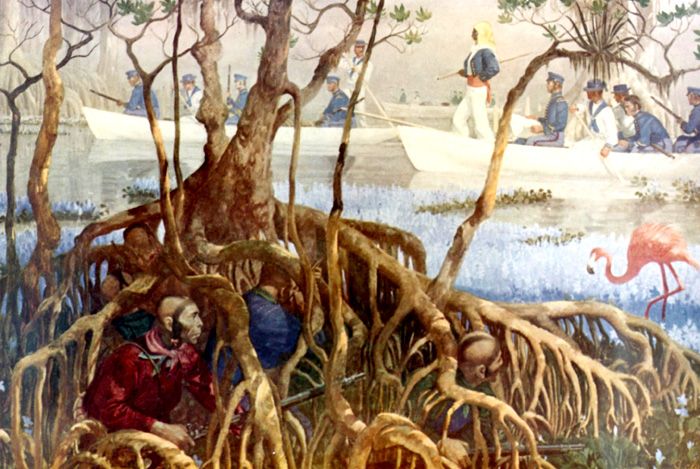
Much of the Seminole Wars were fought in the swamps of Florida
[Taken from Legends of Americahttps://www.legendsofamerica.com/seminole-wars/ ]

[Primary Sources: Aristocrat in Uniform; General Duncan L. Clinch, by Rembert W. Patrick; American Military Strategy During the Second Seminole War, by John C. White, Jr.]