Showing posts with label Hertford County. Show all posts

Sunday, August 2, 2020

Joseph Hewes Remembrance

     Mr. Minton H. Dixon, of Edenton (Chowan County), has caused to be placed in the outside wall of his new and elegant brick store, corner of Main and King streets in that town, a marble tablet with the inscription "Joseph Hew[e]s, one of the signers of the Declaration of Independence, owned and occupied this business site for many years." —Elizabeth City Falcon

"Joseph Hewes." N.C. Highway Historical Marker A-4, N.C. Office of Archives & History.
Joseph Hewes
[Picture taken from NCPedia at
https://www.ncpedia.org/biography/hewes-joseph]

[Murfreesboro Index (Murfreesboro (Hertford County), NC) 29 Apr 1887]

 (Joseph Hewes came to Edenton, NC in 1755 and soon entered into a partnership to form the firm of Blount, Hewes and Company.)


Tuesday, January 1, 2019


A Famous Visitor
Marquis de Lafayette

            Marquis de Lafayette, a 19 year old Frenchman, eagerly offered his service, at his own expense, to fight in the war for American Independence. Although discouraged by Benjamin Franklin, our minister to France, Lafayette bought the ocean-going Victoire and left France on March 27, 1777. The young man fought courageously for the Americans and Washington Irvin wrote about him: “Lafayette from the first attached himself to Washington with an affectionate reverence… it is a picture well worth being hung up in history—this enduring alliance of the calm, dignified, Washington, mature in years and wisdom and the young, buoyant, enthusiastic Lafayette.”[1]    
            He was wounded at Brandywine, but after a short period of time, he was able to accept the command of a division of Virginia light infantry. It was a time of brave men, swords, muskets, horses and intense suffering. Lafayette is best remembered, along with Gen. “Mad Anthony” Wayne and the Comte de Rochambeau, for defeating Cornwallis at Yorktown. The heroic young Frenchman played a noble part in our fight for independence.
Triumphant Return
            In 1824, Lafayette returned to America to make a triumphant tour which included several stops in North Carolina. Much loved by the American people, he was met by thousands of people wherever he went. He was accompanied by his son George Washington Lafayette and Auguste Levasseur, his personal secretary.
            In planning Lafayette’s journey through North Carolina, the sad state of the roads between Richmond and Raleigh forced the party to travel east through Suffolk, VA and Halifax, (Halifax County) NC. His first stop in NC was in Murfreesboro (Hertford County) where he spent the night of February 26, 1825 at the Indian Queen Inn. The difficult journey to Murfreesboro was recorded by Levasseur in Lafayette in America in 1824 and 1825: Or, Journal of a Voyage to the United States.
            “After stopping a few moments among the citizens of Suffolk, we continued on our route to Murfreesborough, where we were to lodge. Our late arrival had the appearance of a nocturnal journey. The bad condition and length of the road had tired our horses, and we thought for a while that we should be compelled to sleep at the foot of the hill on which the town is built. An enormous bonfire, lighted on a neighbouring mountain, whose light displayed our distressed situation; the illuminations of Murfreesborough, which exhibited the appearance of a city in flames; the noise of cannon resounding on our right, with the effect of battery on our flank; the cries of our escort; the whipping and swearing of our drivers, all was insufficient to stimulate our horses, which, sunk in the mud to their knees, appeared to have taken root, refusing to make the least exertion to draw us out of this sad situation, in which we remained about an hour. At length we arrived, and were very amply compensated by the cordial hospitality of the inhabitants of Murfreesborough, who neglected nothing to prove to General Lafayette that the citizens of North Carolina were not less sincerely attached to him than those of the other states.”[2]
North Carolina Highway Historical Marker Program- Murfreesboro, Nc
http://www.ncmarkers.com/Markers.aspx?MarkerId=A-65

Halifax
            Lafayette was escorted from Murfreesboro to Northampton Courthouse at what is now Jackson, (Northampton County) NC and from there to Halifax. They crossed the Roanoke River by ferry and arrived in Halifax at about 5 pm on February 27 amid the firing of artillery and ringing bells. “The mounted escort, consisting of 24 of our citizens …, paraded to receive the General, and proceeded to the river accompanied by the deputation of the corporation and county of Halifax. … The citizens and members of the [Royal White Hart] Lodge were formed in front of the hotel … and a numerous collection of ladies occupied the piazza …. On the arrival of the General in front of the Hotel, he descended from the carriage, was introduced to the persons composing the deputation individually and was conducted through the line to the piazza of the Hotel. The waving of Handkerchiefs by the ladies, the Masonic salutation, the respectful raising of the hat by the citizens, and the universal murmur which ran through the assembly, ‘Welcome Lafayette,’ evinced the deep sensibility which his presence inspired.”[3]
            In Halifax, impressive plans were made for the reception of General Lafayette, including a dinner and a grand ball. The banquet was highlighted by 13 toasts, one for each state. This was followed by the ball after which the visitor spent the night at Eagle’s Tavern.
Eagle's Tavern
Small Town North Carolina
http://www.smalltownnc.com/2013/09/07/historic-halifax/historichalifax_27/

           The next day the party made a stop at the Grove Plantation to spend an hour with Mrs. Willie (Wylie) Jones and her daughter. 


Documenting the American South: Memoirs of a Southern Woman "Within the Lines,"  by Mary Polk Branch, Page 94
https://docsouth.unc.edu/fpn/branch/ill14.html
Rocky Mount   
        They then continued to the village of Rocky Mount at the Falls of the Tar River where they were entertained at Donaldson’s Tavern. The Battle-Evans Mill, built in 1818, stood on the north side of the river in Edgecombe County. The town, south of the river, was in Nash County.
            People from both counties were crowded in a nearby grove hoping to get a glimpse of the Revolutionary hero. A number of people waited in their buggies or wagons. At last, a shout, “He’s here!” and the genial Donaldson came out of the tavern with the postmaster and others who were invited to a banquet hosted by the tavern-keeper. No list of the guest has survived. They spent the night at the tavern.
Donaldson's Tavern Marker located in Battle Park, Rocky Mount, NC
Marquis de La Fayette - Memory Spaces
http//marquisdelafayette-memoryspaces.org/north-carlina-nc/


Raleigh
           They arrived in the Capital at about 12 o’clock on Wednesday. “They were met a few miles from this place by the well disciplined corps of Cavalry under the command of Col. Thomas Polk of Mecklenburg. The General and suite alighted from their carriages, and were introduced to the company individually, after which, preceded by the Calvary and followed by nearly an hundred citizens on horseback, … they proceeded to this city [Raleigh]. At the limits thereof, they were met by the handsome company of Light Infantry… which received them with military honors. Here the General again alighted, and was presented to each member of the company—the interest of which scene was heightened by fine martial music from an excellent band.”[4] 

 An Incident

           In his journal, Levasseur noted the following incident: “The morning of our arrival at Raleigh was near being marked by a very unfortunate accident. In one of the calashes [a light small-wheeled 4-passenger carriage with a folding top] which followed us, was General Daniel of the militia, and a young officer of his staff; their horses ran off, and, the driver not being able to guide them, dashed violently against the trunk of a tree. The force of the shock threw both the riders and the coachman to some distance, but the one most hurt was poor General Daniel, who lay almost senseless upon the spot.
            “Our progress was immediately suspended, and General Lafayette, who, at the time, was a considerable distance in advance of the procession, hastily returned to assure himself of the nature of the accident. General Daniel already began to recover, when the hasty zeal of his friend, General Williams, was upon the point of placing him in greater danger than arose from the fall. This gentleman insisted upon his being immediately bled, and already held the fatal lancet in hand to proceed with the operation, when Mr. George Lafayette besought him seriously to forbear, representing that we had just left the table, and that a bleeding immediately after dinner might be attended with injurious consequences.
            “After having rendered General Daniel the first attentions which his situation demanded, we had him carried to the house of a rich planter, whom we had visited in the morning, some miles off; and, the next day, our wounded friend joined us at Raleigh, entirely recovered from his fall, returning his warmest thanks to Mr. George Lafayette, for having averted the employment of the lancet.                      “I was, at first, much surprised to see this lancet drawn upon such an occasion, but one of our travelling companions informed me, that in the southern and western states, and especially in those where the population is widely scattered, the art of blood-letting is familiar to almost all the great planters. The difficulty of finding a surgeon at the moment of accident often makes it necessary to bleed themselves, which they sometimes do so profusely, that the most hardy phlebotomists of the French school would be alarmed at the sight.”[5]

Raleigh
            “After this ceremony, the procession moved in the following order to the Government House.—First, the Cavalry— then followed the Infantry, succeeding which in an open barouche, drawn by four elegant iron greys, with out-riders, were Gen. Lafayette and Col. Wm. Polk—after which, in carriages, also drawn by four horses each, were George W. Lafayette, M. LeVasseur, the State Escort, &c. As the cavalcade proceeded, a federal salute was fired from cannon placed in the Capitol Square, on reaching which, the General was greeted with the cheers of the assembled multitude. Every door, window and piazza on the street, were crowded with ladies, who manifested their gratification by waving their handkerchiefs, &c.
Original State Capitol in Raleigh before it burned in 1831.
Image by W. Goodacre, Jr. 1831. Call no. OP-14, collection of the State Archives of North Carolina. 

            “On reaching the Government House, the Military filed off on each side leaving a space through which the General, suite and escort passed. In the vestibule, they were received by the Governor and Committee of Arrangements, and conducted to the reception chamber, where were the Heads of Department, Judiciary and other citizens. Governor Burton then welcomed him ….
            “After partaking of some light refreshment, the General was introduced to a numerous party of Ladies, assembled to pay their respects to him. Immediately after which, escorted as before, he proceeded to the East Front of the capitol, opposite Canova’s celebrated statue of Washington, where he was addressed …by Colonel Wm. Polk. …
Statue of George Washington by Antonio Canova
This is a copy. The original was destroyed by fire in 1831.
Located inside the State Capitol Building
Wikimedia Commons
https://commons.wikimedia.org/wiki/File:George_Washington_by_Antonio_Canova_-_DSC05895.jpg
           “At the conclusion, the veteran soldiers, Gen. Lafayette and Col. Polk rushed into each other’s arms, and again wept their gratitude, that they who had borne the brunt of battle together in their youthful prime, had been spared to meet again on peaceful plains and in happier hours. It was a sight which warmed the cold heart of age and made the youthful spirit glow with brighter enthusiasm, and a simultaneous expression of feeling burst forth in a lengthened huzza from the attendant crowd.”[6]
          Back at the Government House, an elegant dinner was provided. The dinner was accompanied by numerous toasts and band music. The company separated sooner than they normally would have in order to prepare for the evening ball.
            “In the evening, a Ball was given complimentary to the General, and also held at the Government House. The pillars in the Ball-room were tastefully wreathed with evergreens. In the centre of the room, surmounting the pillars, appeared in large golden characters, the name of Lafayette. Though no military trophies adorned the walls, no splendid ornaments excited admiration, yet there were two objects which spoke to the memory and feeling—a large full length portrait of Washington and the living presence of his great co-adjutor in the work of glory. There was no need of artificial embellishments, for the ‘human face divine’ shone in all the beautiful variety with which Nature’s cunning hand has painted woman.
            “When we compare the simplicity and plainness with which Gen. Lafayette was received here with the splendor and high wrought scenery of our sister States, we acknowledge that our externals are by no means to be compared—we will contend that in our Republican reception of the man whom all delight to honor, there was as warm a welcome, as pure a spirit of patriotism, as though our walls had been tapestried with cloth of gold, and our floors painted by the first artists of the country.”[7]
            “The next morning, (Thursday) the General, his suit and escort breakfasted with Col. Polk, where he was introduced to three or four old revolutionary soldiers. At 11 o’clock, he took leave of Col. Polk (whose health would not admit of his proceeding farther) in the same affectionate and feeling manner as on his first meeting with this old revolutionary brother officer; and, at about 1 o’clock, took his departure for Fayetteville, attended by the governor, the State escort, and Col. Thos G. Polk’s Calvary.”[8]
Fayetteville
            The Lafayette party arrived in Fayetteville (Cumberland County) on March 4, after a rainy day. This was the first town named for the general after the Revolution.
            “He was met 10 miles from town by the Fayetteville Flying Artillery …. The whole cavalcade proceeded thence, amidst the discharge of artillery, to the Town House, where the troops formed lines on each side of the street, and the carriages, containing the General and suite, passed between them to the east door of the House. Here, alighting from his carriage, with the gentlemen accompanying him, he was met by Judge Toomer, who, in behalf of the Committee and citizens of Fayetteville welcomed him.”[9]
            “After General Lafayette had expressed his gratitude for the reception given him by the citizens of Fayetteville, … we were conducted to the residence of Mr. Duncan M'Rae [sic], where, by the attentions of Mrs. Duncan, our lodgings had been prepared in an elegant and commodious manner. The general was there received by the committee, appointed to supply all his wants.
            “ ‘You are here in your own town,’ said the chairman of the committee to him, ‘in your own house, surrounded by your children. Dispose of all— every thing is yours.’
https://blogs.lib.unc.edu/ncm/index.php/2004/03/01/this_month_march_1825/

            “Every moment of our short stay at Fayetteville was occupied by festivals of gratitude and friendship. Notwithstanding the bad weather, which never ceased to oppose us, the volunteer militia companies, assembled to render military honours to the last surviving major-general of the revolutionary army, would not quit the little camp which they had formed in front of the balcony of the house, whence the general could easily see them manoeuvre. They were still under arms, on the morning of our departure, and we passed in front of their line on leaving the town. It was then that General Lafayette, wishing to give them an expression of his gratitude, alighted, and passing through the ranks, took each officer and soldier affectionately by the hand. This conduct excited the spectators to such a pitch of enthusiasm, that a great portion of the population, willing to prolong the pleasure of seeing him, accompanied his carriage a considerable distance on the road, and only quitted him when the sun was nearly set.”[10]

            Lafayette continued his journey into South Carolina.


[1] The Life Of George Washington, Vol. 3 by Washington Irving, 1856; p818
[2] Lafayette in America in 1824 and 1825: Or, Journal of a Voyage to ..., Volume 2 By Auguste Levasseur: 1829
[3] Halifax Free Press (Halifax, NC) 4 Mar 1825
[4] Weekly Raleigh Register, (Raleigh, NC) 11 Mar 1825
[5] Lafayette in America in 1824 and 1825: Or, Journal of a Voyage to ..., Volume 2 By Auguste Levasseur: 1829
[6] Weekly Raleigh Register, (Raleigh, NC) 11 Mar 1825
[7] Ibid
[8] North-Carolina Free Press (Halifax, NC), 18 Mar 1825, p2.
[9] The North-Carolina Star (Raleigh, NC) 18 Mar 1825
[10] Lafayette in America in 1824 and 1825: Or, Journal of a Voyage to ..., Volume 2 By Auguste Levasseur: 1829

Friday, November 16, 2018


THE JOKER JOKED.
__________

A STORY OF A PRACTICAL JOKE
PLAYED ON PULASKI COWPER.*
__________

An Extract from Cowper’s Reminiscences of the Good Old Times Before the War in Northampton County.

            In his reminiscences in the Patron and Gleaner (Rich Square, Northampton County, NC) this week, Mr. Pulaski Cowper tells of some practical jokes played in the old times in Jackson (Northampton Co.) by Mr. John M. Calvert, who had a keen sense of the ridiculous and a quick perception of a practical joke. After giving some of the jokes Mr. Calvert played on others, Mr. Cowper does not spare himself, but adds the following story, which appeared in the Washington Post some years ago:
            “Some years ago Col. Pulaski Cowper… was reading law in the town of Jackson, the county seat of Northampton County.
            “In the vicinity of Jackson lived Uncle Tom Wheeler. …It is said Uncle Tom was possessed of considerable means though somewhat miserly. At any rate, very few people saw him spending money.
           “One characteristic of Uncle Tom was, when away from home he was never seen without his gun, ‘Old Betsy,’ as he always called it. … Though he never went anywhere without his gun, no one ever saw him with any game.
            “It made but little difference in what direction Uncle Tom started from home to take a ‘little hunt,’ it was always nearer to go via Jackson; and some of his neighbors insinuated that the ‘wet groceries’ had some attraction for him, as it was almost a daily occurrence for him to be seen in town, and while he was ever ready, if drinks were proposed, he was never known to ‘set ‘em up.’
The occupation of Jackson, Northampton County, in 1863.
Frank Leslie’s Illustrated Newspaper, August 29, 1863, p. 368. Neg. 80-455. FP1-46-W79-C582w-C18.
            “This reminiscence occurred during a court in Jackson, and, on account of an important case to be tried, there were a large number of people in attendance, estimated by some at five thousand. Near the court house was the store of Mr. John Randolph. … In the South, the storehouse in the towns and villages is not considered complete without a piazza in front. Randolph’s store had a very large one, on which were seated some fifteen or twenty men, including Uncle Tom. He had set ‘Old Betsy’ inside the store near the door, and he was sitting in the porch. …  
            Col. Cowper had become somewhat weary at the wrangling of the lawyers, over the admission of some evidence, so he took up his hat and walked out of the court house over to Randolph’s store, where he found the crowd in the porch teasing Uncle Tom about always carrying his gun and never having any game and some intimated that they did not believe he could kill anything. 
          Col. Cowper, seeing Mr. John Calvert, who was inside the store, take up the gun, and draw out the shot, leaving only the powder in, and set it back where Uncle Tom had left it, and being confident he had a ‘sure thing’ on the old man, joined in with the others in teasing him. Col. Cowper proposed to bet treats for the crowd that Uncle Tom could not hit his hat, if placed on a large oak stump about fifteen feet off. (Col. Cowper had on a fine silk hat, for which he paid $5.00 the day before.) Uncle Tom said ‘Well Laski,’ (that’s what he always called the Colonel) ‘I don’t want to hurt your new hat, but as you insist upon it, and propose drinks for the crowd, and as I feel a little dry, if you will let me take a rest, I’ll see what Old Betsy can do.”  
            “The Colonel said, ‘All right, you can take a rest, and sit down too, if you like.’ He sent five of six boys around town to tell everybody to come quick round to Randolph’s store, there was going to be a ‘free treat.’ He and Uncle Tom then went to the oak stump to put the hat in position. It was some little time before Uncle Tom could place the hat just exactly as he wanted it. While all this was going on, John Calvert took up the gun, which was near to the shot pouch, and filled her about half full of shot and set it back in place.
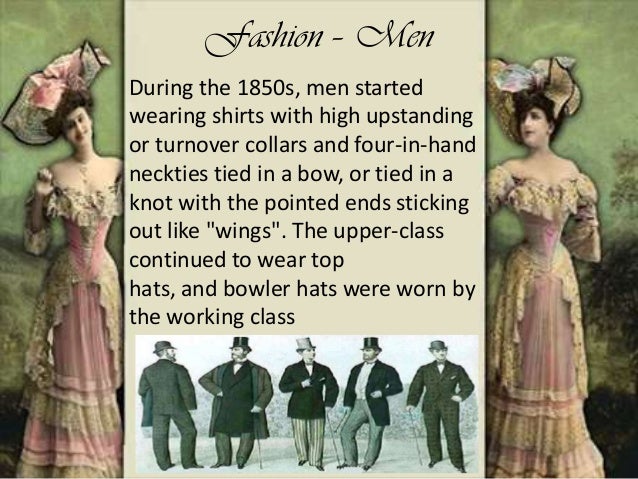
Starting from the 1890s, the blazer wasintroduced, and was worn forsports, sailing, and other casual activities.Throughout...
Taken from "Fashion in the Victorian Era and Regency Period"
https://www.slideshare.net/shahansaheed/presentation1hghgfhhgdhghh
            “Everything in readiness, Uncle Tom took up his gun, remarking, ‘Old Betsy, you have never failed me. Now do your best.’ Seating himself in a chair he rested the gun on the railing, took aim, pulled the trigger. Uncle Tom was picked up at the other end of the piazza, and the gun went cavorting through the air, and landed on the other side of the street. The hat, not a piece of it as big as a ten cent piece, could be found in the whole town. ‘Snaked by jings,’ exclaimed Col. Cowper. ‘A conspiracy—some one has played fool on me, but I’ll set ‘em up.’ All were invited to a saloon near by, where he arranged with the proprietor for drinks for the crowd. The Colonel then went to the hotel to get his dinner, and about two o’clock p.m. the line was formed, and the drinking commenced. They would go in at the front door, get a drink, and pass out at the rear.
            “About sunset the colonel went over to settle the bill, when to his astonishment, the drinking was still going on. The line had resolved in a ring, and was repeating, and ever and anon there would go up a yell, ‘Rah for Cowper.’ He called a halt on the bar-tender, who, knowing the Colonel’s ability to pay, was keeping the glasses filled. He asked for the amount of the bill. The proprietor told him it would take some time to count it up, as he had chalked it down on the side of the house. The Colonel asked how many barrels they had drank, and was told about two. He said he would pay for it at wholesale prices, and it was compromised for $117.50.
            “Colonel Cowper became so disgusted with the whole affair that he resolved to give up the study of law, and immediately packed his trunk, and hired a man to take him to the railroad. Just outside the town, on ascending a hill, an obstruction was noticed in the road. The driver got down to see what it was, and reported that a cart was bottom upwards. They took hold to remove it, when a voice underneath stammered out, ‘Hic: come in boys, free treat—rah for Cowper.’
            “Reaching the station, the colonel took the first train for Raleigh, (Wake County) where he opened an insurance office, and he is today considered one of the best and most reliable insurance men in or out of the State.”

[From the News and Observer (Raleigh, NC) 8 April 1897]

*Pulaski Cowper (1832-1901) was the son of  Lewis Meredith and Annice Collins Cowper. He grew up in Murfreesboro, Hertford County and studied law under Thomas Bragg of Jackson, Northampton County. He became private secretary to Thomas Bragg when he became governor. During the Civil War, he was clerk to Gen. Mallet in the conscript Dept. in Greensboro. After the war, he became involved in the insurance business, and for a number of years was the president of the North Carolina Home Insurance co. of Raleigh. 

            Cowper write for the University Magazine in Chapel Hill and for several newspapers. He also wrote biographies of Gov. Bragg, Judge David Caldwell, and compiled letters of Gen. Bryan Grimes to his wife during the war.


Thursday, September 28, 2017

Many Living Picture Devices


            There appears to be no end to the varieties of projecting apparatus that are being placed on the market. Here is a list of a few which are already being exhibited at the various music halls and places of public entertainment: The motorgraph, the animatoscope, the theatrograph, the kinematograph, the projectoscope, the cinemetoscope, the vitascope, the cinematograph, the veriscope, the animatograph, the viveoscope, the eidoloscope, the cinagraphoscope, the biograph, the rayoscope, the magniscope.

 [Article taken from the Eastern Courier (Hertford, NC) 16 Sept 1897]


The eidoloscope, was first demonstrated in April 1895. It was built by the Latham family. In May 1895, the Lambda Company filmed a prizefight on the roof of Madison Square Garden in New York. Consisting of four rounds lasting one minute each and punctuated by 30-second breaks, the event lasted for about eight minutes. The Lathams recorded the fight in its entirety—rounds plus rest breaks—and projected the film for eight nonstop minutes. They’d solved the problem of tension on the filmstrip.[1] It incorporated a simple solution to the film breakage problem in the form of a loop in the film before it passed in front of the lens. The jerking of the intermittent mechanism thus pulled only on this inches-long loop, not on the whole reel. This innovation would become an integral part of the modern movie camera. It is called the “Latham Loop” but was actually invented by Eidoloscope Company employee Eugene Lauste, working for a salary of $21 a week.[2]


[1] FROM THE MAGIC LANTERN TO THE PROJECTED MOTION PICTURE: http://cinemathequefroncaise.com/Chapter1-2/CHAPTER_01_PART_02.html#F1.28
[2] THE FIGHT THAT STARTED THE MOVIES: The World Heavyweight Championship, the Birth of Cinema and the First Feature Film by SAMUEL HAWLEY (Nov. 5, 2016): http://www.samuelhawley.com/The-Fight-That-Started-the-Movies.html

Sunday, May 22, 2016

LAYING THE CORNER-STONE.
____________

REPORTED BY OUR BUSINESS MANAGER
____________

            Saturday, October the 1st (1887), was a big day in Windsor. The people of old Bertie turned out in full force to witness the laying of the Corner-Stone of the new Court House, a building (judging from the drawn plan we saw displayed) of pleasing proportions and excellent architectural beauty.
            The large procession, formed at the Masonic hall and led by the Edenton (Chowan County) Cornet Band, marched through several of the principal streets and then to the Grand Stand in the Court yard, where the exercises appointed for the occasion were had. The Grand Marshal opened the ceremony, making a few appropriate and well-timed remarks, which were followed with prayer by the Worthy Chaplain; after which the stone was slowly lowered to its destined place in the structure while the band played a soft and beautiful air. The stone dropped in its bed at 12 M. The Masonic fraternity then went through with the form usual on such occasions, that of depositing a box containing tokens, etc., of the present. The following are some of the articles deposited:

The oration delivered on the occasion by F. D. Winston. A copy of the Windsor Public Ledger containing resolutions of respect in memory of W. P. Gurley, late W. M., of Charity Lodge No. 5, A. F. and A. M. A copy of the Act of Legislature authorizing the rebuilding of the Bertie Court House. A photograph of L. S. Webb Esq., the oldest citizen of the town of Windsor. A photograph of the former Court House. The names of the Presidents and Vice Presidents of the United States, the names of the officers of the State of North Carolina, the names of the officers of Bertie county, the names of the officers of the town of Windsor.

            Mr. Frank D. Winston, the orator of the day, was introduced and for some time held his audience wrapped in admiration of his eloquence as he spoke of the past, hailed the present and painted the future. The following facts from the address we noted with interest.

            The County of Bertie was established in 1722 by the General assembly in session at Queen Anne’s creek, near Edenton. It was carved out of Albemarle county and embraced all that part of Albemarle county lying on the west side of Chowan river, bounded to the Northward by the line dividing the government from Virginia and to the southward by the Albemarle sound and Morattuck (now Roanoke) river as far u as Welches’ creek and then including both sides of the said river and the branches thereof as far as the limit of the government.
            In 1741 a part of the upper boundary of Bertie was formed into the county of North Hampton. In 1754 the Northern end was made the county of Hertford, and all of that part on the west side of Roanoke river was added to the County of Edgecomb(e). 
            The County Seat of Bertie precinct in 1722 was established near St. Johns—now in Hertford county. In 1742 the seat of government for the county was located at Walfington, two miles north of Windsor on the Cashie river, at Wills’ Quarter Bridge. In 1774 Windsor was made the county seat—it having become an incorporated town in 1767. The old Court House was commenced in 1775 and work was suspended on it by reason of the R4evolutionary war. It was completed in 1788. The two wings were added in 1822. The contract for building the new Court House was let out in June 1887.

            After the speech of Mr. Winston concluded, dinner was announced. There were two tables, one at the hotel for the ladies and one on the grounds in the rear of hotel for gentlemen. The Masons were marched to their hall by the band. After dinner the Lewiston (Bertie County) Band and Edenton Band occupied the upper porch of the American hotel and entertained the crowd for the evening. The whole affair was conducted in a most admirable way reflecting untold credit upon its managers and betokening a noble public spirit on the part of the entire people.

From Courthouse History.com
http://courthousehistory.com/gallery/states/north-carolina/counties/bertie
____________


[Fisherman and Farmer (Edenton, NC) 7 Oct 1887]

Thursday, February 25, 2016

Plea for Aid
Local Militia in Dire Straits

War of 1812


The following counties of the Detached Militia were called into service at Norfolk, Virginia by orders in September of 1814 - Bertie, Chatham, Edgecombe, Franklin, Gates, Granville, Halifax, Hertford, Johnston, Martin, Nash, Northampton, Orange, Person, Wake, and Warren. Those from Chatham, Orange, and Person were ordered to return to their respective homes before they arrived at Gates Court House, the place of rendezvous.

ADDRESS

To the citizens of the counties of Hertford, Bertie, Martin, Northampton, Halifax, Nash, Edgecombe, Johnston, Warren, Franklin, Granville and Wake, and to the patriotic citizens of North Carolina generally.

The undersigned take the liberty of addressing you in behalf of the volunteers and drafted militia, detached from the several counties above named for the service of the United States, and now stationed under your command at Norfolk. — It is known to you that these men were suddenly called from their homes, without being afforded an opportunity, and many of them not possessing the ability, to make the necessary preparations for a six months tour of duty at an unknown season. The United States do not furnish clothing to the militia in their service—most of your friends and neighbors, therefore, who have repaired hither, to the post of danger, are entirely destitute of the clothing necessary to protect them from the inclemencies of the approaching season. Already they have suffered much from the want of these conveniences which their situation required, and we take pride in saying they have born those sufferings with a cheerfulness, patience and constancy, highly honorable. It will be impossible for them, however, to withstand the rigor of the approaching season unless they are provided with blankets and comfortable woolen clothing.

The only means by which we believe the wants of these troops can be speedily and effectively supplied, is by the appeal which we now make to your benevolence, patriotism and humanity—an appeal which we are sure will not be made in vain. We cannot believe that your patriotism will suffer the brave men, who have marched with such alacrity to the post of danger, and who are willing to risk their lives in their country’s defense, to perish by the severities of the season for want of the common conveniences of life… when it can be so easily afforded—We seek voluntary contributions from you, therefore, either in woollen clothing and blankets, or in money, at your discretion. Let receivers be appointed in each county, and let them transmit, without delay, the amount received, together with the names of the generous donors, to one of the field officers, who will be responsible for its faithful distribution. You will thus enjoy the sweet reflection of having snatched from the grave many a suffering soldier, and of having performed your duty to your country, to your friends and neighbors, whose gratitude will follow you through life.

We are, with sentiments of the highest respect, Your obedient servants,

D. McDonald, Col. 1st Reg. NCDM
A. Joyner, Lieu. Col.
Jos. F. Dickinson, Major
John C. Green, do. (?)
James Iredell, Captain
John J. Inge, Captain
John Bell, Captain
Harry Bryan, Captain
John Green, Captain
Isaac Watkins, Captain
John L. (?) Laughter, captain
John F. (?) Walker, Captain
H. G. Williams, Captain\
Cantonned near Norfolk, 20 Oct 1814

[Political Synopsis, 17 Nov 1814, Tarborough and North Carolina – The War of 1812 website: http://www.carolana.com/NC/1800s/antebellum/war_of_1812_military_units.html]


Wednesday, April 16, 2014

Early Travel


This is a 1900 ad for the Albemarle Steam Navigation Company, which operated steamers out of Franklin, Virginia to Hertford County ports on the Chowan and Meherrin Rivers to Edenton, in Chowan County, and then back to Franklin, Virginia.


Tuesday, March 26, 2013

Northampton Celebration - 1894


From the Jackson,, NC website:
http://www.historicjacksonnc.com/jackson_nc_history.php

 
Jackson, the county seat of Northampton County, NC, got its first railroad in 1894. It served Northampton and Hertford Counties. The formal opening of the new rail line took place in Jackson on January 18 of that year. The following is an that occasion.

The Banquet
At six o'clock a banquet was served at the Burgwyn Hotel, which is a model country inn kept by Mr. James Scull. The banquet hall had been beautifully decorated with evergreen and bunting, and banners with appropriate inscriptions and monograms adorned the walls. Among these was a German flag displayed in honor of Manager Kell who is a native of that country. The tables were covered with snow-white linen and groaned beneath the load of good things thereon. I did not hear the tables groan and do not know why they should have done so, but I use the regulation phrase to be in fashion. I will remark, however, that I slept in the room that night with some of those who feasted at the banquet and I heard them groan in their sleep, and I knew why.

The menu consisted of Lynnhaven oysters, salads, cold meats, escalloped oysters, ice cream, cake, fruits, nuts, and raisins, together with a delicious article of champagne. The decorations, the arrangements, and the menu were the work of the ladies and their work was simply perfect. These ladies were Mesdames M. M. Randolph, R. A. Weaver, W. P. Moore, John E. Moore, J. A. Buxton, S. N. Buxton, B. S. Gay, James Scull, H. W. Lewis, and Misses S. E. Peebles and Pattie Peele.”

The Toasts
Mr. John Burgwyn MacRae was toastmaster and very gracefully and intelligently did he preside. The toasts and responses were as follows:

Our Guests; response by Mayor C.G. Peebles; the Northampton and Hertford Railroad; response by Dr. H. W. Lewis. The Ladies; response by Mr. J. Burgwyn MacRae, Gumberry; response by Captain R. B. Peebles; the Press; response by Mr. H. B. Hardy of the North Carolinian and Mr. W. S. Copeland of the State. President Clark. Superintendent Whisnant of the Seaboard Air Line, and Mr. T. J. Anderson, general passenger agent of the same line, were also called for and gracefully responded. Everything went off without a hitch and the management was admirable. The committee in charge were Messrs. H. W. Lewis, J. A. Buxton, J. B. MacRae, W. W. Peebles, B. S. Gay, G. P. Burgwyn, W. P. Moore, J. S. Grant, S. J. Calvert, R. A. Weaver and D. A. Jordan.

Borjes orchestra from Norfolk furnished delightful music for the occasion.

The Ball
After the banquet, a grand dress ball was given at the hotel and the belles and beaux of Northampton and adjoining counties were seen in all their glory. Mr. George S. Urquhart, who was, until Mr. Kell came, the “King of Gumberry” (if Captain Peebles is authority) was master of ceremonies and those who knew him needed not to be told that his management was superb. He was well assisted by Mr. E. J. Peebles, who has always been a general favorite with the young folks. Captain R. B. Peebles and his handsome wife and his charming daughter also contributed their full share to the enjoyment of the dance.

Among the ladies present were Mrs. Dr. Moore, in lilac china silk; Mrs. R. B. Peebles, black silken train; Mrs. J. W. Weaver, white bengaline silk, pearl trimming; Mrs. J. T. G. Gooch, terra cotta silk; Miss Kate Prescott, old rose silk, cream lace; Miss Eliza Grant, cream cloth; Miss Nita Selden, blue and white crepon lace; Mrs. Charles Gay, cream cloth; Miss Wingfield of Portsmouth, cream crepon cloth; Miss Wilson, of Portsmouth, pink cashmere; Miss Mabel Picard, pink cashmere, lace, pearls; Miss Sallie Peebles, cream cashmere and ribbon; Miss Sue Urquhart, cream cashmere and ribbon; Miss Dancy, pale green crepon; Miss H. Peebles, cloth and fur; Miss Annie Sancell, pink crepon, lace; Mrs. F. Kell, black silk; Mrs. Phil Meisel, black silk; Mrs. A. L. Bundy, cream silk; Miss Bena Gay, figured organdy, lace; Miss Mamie Lee, rose colored silk; Miss Hazeldine, steel silk; Miss Kittie Hazeldine, black silk; Miss Drewett, steel silk; Mrs. R. F. Keeling, brown henrietta and velvet; Mrs. B. H. Mock, black silk; Miss Lillie Grant, blue silk; Miss Annie Peebles, becoming dress of black.

Mr. George P. Burgwyn, Mr. S. J. Calvert, Mr. B. S. Gay, Mr. Faison Calvert, Dr. Rob Stancell, Mr. William Barrow, and other citizens exerted themselves to the utmost to give everybody a good time, while Mr. R. A. Weaver of J. P. Yancy & Co., and Dr. W. P. Moore fairly outdid themselves in acts of generous hospitality.

Mr. J. W. Zeaver, Rich Square, was present with his bride, who was one of the prettiest women in the company.

Mr. Kenneth Barrow, an old Jackson boy, but now with the Norfolk and Carolina railroad, was on hand and received the cordial greetings of his friends.

Mr. J. S. Grant, proprietor of the Cleveland Hotel conducts the “Administration House,” which is as popular as its namesake.

Exactly forty years later on January 18, 1934 the current manager, H. O. Carlton, announced the intended abandonment of the Northampton and Hertford Railroad.

 
[Taken from Footprints in Northampton : 1741-1776-1976. (Rich Square, N. C. : The Committee), 1976.     http://digital.lib.ecu.edu/16815 ]

Monday, October 29, 2012


February Court in Gatesville in the 1920s


By: Dick Carter


 Having moved from Roduco to Gatesville [Gates Co.] in 1918, I learned the comings and goings of things that happened in the 1920s and 1930s. One special event came on the first Monday in February— this being in the time of few cars and no tractors. Farmers and local residents met in Gatesville on this day to trade horses and mules before spring plowing started.
There was in Gatesville at that time two livery stables—one was located where the Gatesville Baptist Parsonage now stands. It was owned by Jim Hoffler. Both of the stables traded, bought and sold horses, mules, buggies, harnesses, etc.

On Sunday afternoon late you could see the horse traders coming to Gatesville driving one mule or horse and leading about three or four behind—all roads were sand at that time. They came from Ahoskie [Hertford Co.], Suffolk [VA], Edenton [Chowan Co.], and other places and made camp in the street behind the courthouse and in front of the jail and other places that they could tie up.
At about sunrise on Monday morning the fun started and continued on during the day—horse trading, drinking corn liquor, cooking over open fires, fist fighting, and cussing (some of the best you ever heard). The Langston’s from Gates and the Carters from across the Creek always put on a good fight. When the fighting got real good old man Charlie Ellis, an undertaker that had a place where Southern Bank now stands would stand on the side and sing, “Shave Mr. Shaver and grease Mr. Greaser Grease". One day when the fight got real good, Tom Riddick, a boy of my age at that time, got on top of the chicken house in order to better see the fight. Well the roof fell through—from that day on he was known as Rooster Reddick. However, when you called him that you had better be prepared to run or fight.

Down Main Street toward the Creek about where the Askew home now stands, under a large sycamore tree, two colored women, "Mariar and Sane", lived in a small house and had food for sale, such as it was. They cooked the best apple jacks for 10 cents that you ever ate. I guess this was Gatesville's first fast food.

Needless to say, the bootleggers had a good day. White corn liquor was 35 cents a pint. It was said to be two-man liquor—one man would hold the other while he took a drink.
At about 4:00 pm everything moved out leaving the alleyways strewn with paper, hay, food, horse manure, etc. Everyone was happy—some made good deals, some bad. But everyone was looking forward to next year, the first Monday in February.

[Taken from Just Down the Road in Our Own Words, compiled and typed by Peggy Lefler for the Gates County Historical Society: 2009]

Monday, December 27, 2010

Aulander [Bertie Co., NC]
High School Football Team
c 1927


Undefeated and Untied
Squad Includes Players from Hertford County as well as Bertie County

Front Row: Crawford Lawrence - Bruce White - Lloyd Britton - William "Zeke" Mitchell

Second Row: Pete Corey - P. C. Bradley - Harry Parker - Rudolph Mitchell - Burleigh Jenkins - Phil Burden

Third Row: Stanley "Monk" Joyne - Coach George Underwood - Harry Holloman - J. T. Early - Whitney Saunders - Vernon "Fats" Cowan - Heber "Dick" Newsome - Chet Rogerson -Clayton Rogerson

[In the 1920s few restrictions existed on high school sports.]

[This photo was taken from the Aulander website: Aulander, NC: Past, Present and Future.]