Showing posts with label Florida. Show all posts

Saturday, November 17, 2018


Hero of Withlacoochee
___________________________

Duncan Lamon Clinch

Nash County, NC Native
___________________________

Seminole Indians Prevail in Western Florida

            It was a moment of indecision for the 27-year army veteran, Gen. Duncan Lamon Clinch, as he sat on his horse watching the Withlacoochee River, in western Florida, swirl before him—deep and 150 feet wide. He had expected to find a place where his men could ford the river, but torrential rains had made that impossible. The Seminole Indians, led by Osceola, were somewhere on the south side of the river, while he, with his 750 soldiers, was on the north side with no boats or rafts. What led to this dilemma?
Seminole Chief Osceola
[Taken from Legends of America
 
https://www.legendsofamerica.com/seminole-wars/ ]
            In 1834, Clinch was assigned to oversee the "peaceful and harmonious removal of the Indians [from Florida], according to their treaty with the U. States." He soon became convinced that "… they have not the least intention [of leaving] … unless compelled to do so by a stronger force than mere words." At a conference in March 1835, Clinch met with individual Seminole chiefs, hoping to persuade them to agree to move the following spring. He tried to convince them "of the utter folly of attempting to resist …; as it would bring misery and ruin upon their wives and children and on their Nation."
            At a council on April 22 the Indian chiefs all expressed opposition to the proposed move. However, Gen. Clinch declared that "he had been sent here to enforce the treaty; he had warriors enough to do it, and he would do it." The next day, 8 chiefs agreed to abide by the treaty, while 6 refused. The Indian agent, Wiley Thompson, declared the 6 resisters were no longer chiefs, and scratched their names from the roll of council members.
            During the summer of 1835, as plans were made for the Indian removal, it became evident that many of the Indians would not go peacefully. By October, Cinch was convinced there would be war. The settlers felt threatened and were demanding protection. There were not enough troops to fight the Indians and patrol the settled areas. The government, underestimating the number of Indians in the area, thought a "show of force would cow the Indians into submission; they utterly failed to comprehend what a determined band—even a band of poor fighters—could accomplish. …"


            In November, in preparation for war with the Indians, General Clinch began to move his men to his plantation, Auld Lang Syne, where he built Fort Drane. There were six companies of regular army troops, totaling about 250 men. On Dec. 24, Gen. Richard K. Call arrived with 560 mounted militia. Clinch was confident of his ability to defeat the Seminoles. However, the optimistic General was unaware that the militia under Call had only agreed to serve until Jan. 1, 1836—only a few days more.
            An Indian scout informed Clinch that the Indians were gathering at a town about 35 miles south of the Withlacoochee River and plans were made for an immediate attack. Unknown to Clinch and Call, however, the Seminoles had attacked first. On December 25, the Second Seminole War began with furious Indian attacks on plantations across Florida.
            Gen. Francis Dade had been ordered to march his troops along the military road from Fort Brook in southern Florida to Fort King in the north to assist Clinch. When Gen. Call learned of this, he told Clinch that the only thing that would save Dade was to have disobeyed the order to march. "Disturbed as the country is through which he must pass, he can never reach you."
            Call was right. On Dec. 28, the Indians ambushed and massacred the troops on their march, leaving only 2 survivors to tell the story. On the same day, Osceola killed Indian Agent Wiley Thompson. Gen. Clinch was unaware of those developments as he prepared to leave Fort Drane.
            On Dec. 29, Gen. Clinch, Gen. Call and their force of about 750 men left Fort Drane, marching south toward the Withlacoochee River. Gen. Call advised Clinch to move speedily to reach the Indian town, but Clinch did not agree. Call later declared that Clinch "… set out with every cart and wagon, mule and horse, he could raise on his plantation, or among his troops." With the noise of "horses pulling wagons out of the mud, and men struggling to carry supplies through the swamps," along with dogs running back and forth, flushing birds and barking fiercely, the army's arrival at the river would be no surprise to the enemy. It took three days to reach the Withlacoochee River instead of the expected one day.
Clinch Makes a Decision
            As Clinch surveyed the raging river, trying to decide whether to continue his march or to retreat to Fort Drane, he was certain he had the superior force, and that the destruction of the Indian village would make the Indians agree to the migration. However, the one thing he had not included in his supply train was boats or rafts. The only vessel available to the army was one abandoned, leaky canoe. With two men paddling, no more than 5 men and their equipment could be carried across on each trip. The transfer would take hours. Unaware that war had already begun and that the Indians were waiting in ambush, he decided to move his men across the river. After all, this was the only day he would have the volunteers as they would be free to leave the next day.
            The canoe made trip after trip, moving the regular troops to the south side of the Withlacoochee River. With no Indians in sight, the men who had been transported marched about 500 yards and stacked their guns and rested. Scouts pointed to signs that a large band of Indians had been there recently, but the transportation continued.
            It was 12:30 by the time the regular army was safely on the south side of the river. They made their way to a clearing surrounded on three sides by hammocks [elevated areas covered in trees] thick enough to conceal enemy warriors. The open terrain presented a perfect killing zone, and the Indians took full advantage of it. The regular force, resting in the middle of the open field, was ambushed by an army of 250 Seminoles led by Osceola. "… [T]he woods seemed to belch shot and sound. … Soldiers grabbed their guns and quickly formed a two-man-deep line of battle. … The regulars returned a devastating fire that drove the attackers back among the protecting trees."
            When Clinch reached the scene, he ordered the men to spread out and charge the Indians. At one point, the general shouted, "Men, I am ready to die on the spot if necessary, but not to retreat."
            The Seminoles fell back to regroup. During this time, about 50 volunteers managed to cross the river to aid the regulars. The volunteers quickly formed two companies and anchored themselves on the flanks of the regulars to prevent them from being cut off from the river. Clinch led his men in two more fierce charges, walking back and forth along the line after his horse was wounded. Finally the Indians retreated into the trees and swamp. The soldiers had held their line.
            The battle lasted about an hour. Clinch reported that he had 4 men killed and that over 100 Indians had died. The number of Indian casualties was never verified. One soldier, Lt. Chubb, displayed 2 scalps. His wife was not the most "credulous of wimen" and he needed evidence to convince her and his neighbors of his bravery.
Fierce Warriers


Dade Massacre, Florida
[Taken from Legends of America
https://www.legendsofamerica.com/seminole-wars/ ]

            In his book, Aristocrat in Uniform, Rembert Patrick described the Indian warriors: "The savages … made a most terrifying picture; their almost naked bodies painted in brilliant colors of war, their heads shaved except for a tuft of hair on top (which seemed to indicate both their willingness to be scalped and their desire to take souvenirs from the heads of the soldiers), and their bloodcurdling yells that echoed through the forests." Later, those who took part in the battle were to recall the "continual screeching and yelling of the Indians. … Their war cries began with a low growling noise and rose to a final crescendo that burst into a fiendish, nerve-shattering yell. After each shot the Indian uttered his frightful whoop, threw himself leftward to the ground (to confuse the soldiers who often fired directly at the flash of the Indians musket), and in his prone position hastily reloaded his gun."
Return to Fort Drane
            Clinch decided not to continue his march. Their supplies were inadequate to continue, the term of enlistment was over for the militia, and there were many injured soldiers that would hinder any movement of the command. Cypress logs had collected at a bend in the river and these were lashed together, along with the canoe, to form a crude bridge across the river. By evening, all the men were safely back on the north side of the river. Some horses and many guns were left behind and retrieved by the Indians. On Jan. 1, 1836, the army retreated back to Fort Drane. The Seminoles now believed that they could hold off any invader in their homeland.
            This was Gen. Clinch's largest battle during nearly 28 years of army service. He had underestimated the enemy and had suffered what many deemed a defeat. However, he could be proud of his performance under fire and the fact that he brought his troops home with only 4 casualties.
            Later, Osceola sent Clinch the following message: "You have guns and so have we; you have powder and lead and so have we; you have men and so have we; your men will fight, and so will ours until the last drop of Seminoles' blood has moistened the dust of his hunting grounds."
            A private who served under Clinch wrote the following to a New Hampshire Paper: "General Clinch received several balls in his clothes, and one through his cap, passing not an inch above his head. … when the balls pored like hail around him, not a muscle of his face moved …; a majority of the Indians present, probably knew him personally; … their fire was directed particularly at him—but he quailed not, calmly giving his orders and attending to their execution. … " In later years, he became known as the "Hero of Withlacoochee" and "Old Withlacoochee."
            This marked the beginning of what would be 7 years of savage war with the Seminoles that finally ended in 1842. The army captured many Indians, especially women and children, and moved them to the Indian Territory. About 500 Seminoles managed to hide in the Everglades and swamps of southern Florida where the white men were afraid to venture. The price of the war was the lives of over 1,500 solders and $20 million. It is unknown how many Seminoles died.
Life of Duncan L. Clinch
            Duncan Lamon Clinch was born in Nash County, NC on 6 April 1787. His parents were Mary Lamon and Joseph John Clinch. Mary was the daughter of Duncan Lamon who was well known in Nash and Edgecombe Counties. He received a grant in 1761. He served in the provisional congresses of NC and was a justice of the peace in Nash Co. after its establishment in 1777.
Portrait of U.S. General Duncan Lamont Clinch - New Smyrna, Florida
Portrait of U. S. General Duncan L. Clinch - New Smyrna, Fl. 18--
Black & white photoprint, 8x10 in. State Archives of Florida, Florida Memory.
https://www.floridamemory.com/items/show/31295,accessed 17 November 2018.
            Duncan's father, Joseph Clinch, moved, as a child, with his family to Edgecombe County, NC from Isle of Wight Co., VA. The family settled near Tarboro, NC. Joseph joined the Continental forces on April 22, 1776 and family records indicate he was briefly an aide to Gen. George Washington. He returned to Edgecombe Co. and raised and equipped a militia regiment. After the Revolution, Joseph acquired land in Nash Co. and built a house on Swift Creek near the present-day Rocky Mount, NC. A bridge across the creek is still known as Clinch's Bridge. Joseph's wife, Mary, died in 1792, and Joseph died in 1795. Thus, Duncan Lamon Clinch was left an orphan at the age of eight. He received 378 acres of land from his father's estate, which he sold to William Bellamy in 1809 for $1200. No other records of his childhood have been found.

[Taken from Faith and Heritage: A compilation of Nash County historical notes]
            In 1808, US Congressman Thomas Blount recommended Duncan for a commission as a First Lieutenant in the Third Infantry of the U.S. Army. He was promoted to Captain in 1810, Lt. Col. of the 43rd Regiment in 1813, Col. of the 8th Regiment in 1819, and Brigadier General in 1829.
            After the Battle of Withlacoochee, he continued to fight the Indians as part of Maj. Gen. Edmund P. Gaines' force until he retired September 21, 1836. He settled on a plantation near St. Marys, GA and was elected as a Whig to the Twenty-eighth Congress to fill the vacancy caused by the death of John Millen.
            In 1847, Georgia Whigs selected the "Hero of the Battle of Withlacoochee" to be their candidate for governor. He was defeated.
            Duncan Clinch was married first to Eliza Bayard McIntosh. Theirs was a love match and they had 8 children: 1) Eliza Bayard Clinch, who married Robert Anderson, who defended Fort Sumter in 1861; 2) John Houstoun Clinch, married Elizabeth Higbee Waldburg, of Georgia; 3) Mary L. Clinch; 4) Duncan L. Clinch, married Susan Hopkins, of Georgia; 5) Catherine M. Clinch, married Barnwell Heyward, of SC; 6) Henry A. Clinch, married Ella Ford; 7) Nicholas Bayard Clinch; and 8) George W. Clinch, married Catharine Ferris, of Florida.
            In 1834, when Clinch was transferred to Florida, Eliza remained in Mobile, AL with the children. In March, 1835, their son, Duncan, 9 years old, contracted scarlet fever. Eliza sent the other children away and nursed little Duncan until he began to recover. On April 10, she joined her other children for a shopping trip. The next morning, she was stricken with fever, and, tired and worn from her son's illness, she died on April 15.
            After his retirement in 1836, Clinch married Elizabeth Bayard Houstoun, who had helped to care for Clinch's children after the death of Eliza. Elizabeth was in her mid-thirties and had never married. She was a good mother to the children and helped Duncan refurbish his home. She died in August, 1838.
            Duncan Clinch married a third time, to Sophia Hermes Gibbs Couper, an attractive 33-year-old widow, in February 1846. His third marriage, like his first, was a love match. Sophia lived until 1903.
            In 1849, Damon Clinch and his family stayed later than usual at their summer home in Habersham County, GA. They left by stagecoach in November, taking a train from Athens, GA to Atlanta. From Atlanta, they went on to Macon where Clinch was forced to rest. He died there on Nov. 27, 1849. He was buried in Bonaventure Cemetery, in Savannah, GA. The Southern  Whig reported, "The distinguished patriot and soldier is no more."
            In 1851, Clinch County, GA was established on the Florida border in honor of Duncan L. Clinch.

            (The Seminoles were Creek Indians who fled to Florida, controlled by Spain, to escape being enslaved by the British. They adopted many ways of the white man. Many blacks that had escaped slavery in Georgia and the Carolinas came to Florida and lived near the Seminoles. A union was formed between them because they had a mutual fear—slavery. The bond was so strong that the U.S. could not break them apart. The blacks became known as the black Seminoles.)
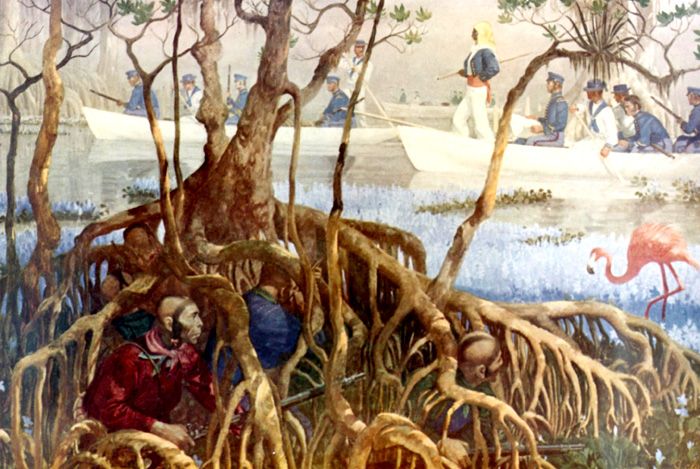
Much of the Seminole Wars were fought in the swamps of Florida
[Taken from Legends of Americahttps://www.legendsofamerica.com/seminole-wars/ ]

[Primary Sources: Aristocrat in Uniform; General Duncan L. Clinch, by Rembert W. Patrick; American Military Strategy During the Second Seminole War, by John C. White, Jr.]

Saturday, October 22, 2016

PERFECT FLYING MACHINE

            We shall get a perfect flying machine all right and pretty soon. Charles Hamilton tried out his aeroplane in Florida Sunday, but fell 325 feet on a board walk. All  he said was, “Dang it, I’ve lost my cigar!”—New York Telegram.


[The Raleigh Times (Raleigh, NC) 30 Jan 1906]

          Charles K. Hamilton, who would go on to become the twelfth person to earn an American pilot’s license, flew the device. Hamilton gripped a tow rope tied to an automobile that pulled his aircraft along the beach by driving quickly across the sand. Once Hamilton left the ground, he released the tow rope and glided, shifting his body weight left and right to steer. The glider flew for about 150 feet before one of the wing ribs broke, sending it crashing to the ground. The glider was seriously damaged, but Hamilton survived.

Preparing for Florida’s first glider flight at Ormond Beach near Daytona. Charles Hamilton would soon fly this glider into the air over Florida’s Atlantic coast (1906).
[The Florida Memory Blog:
https://www.floridamemory.com/blog/tag/gliders/]


Thursday, July 7, 2011


“Glory” Battle Hancock

Heroine of the Great War


 “War is hell!” British Red Cross nurse, Madelon “Glory” Battle Hancock, wrote to her father and stepmother from the Belgian front in 1918. “I’m still on the front & such days & nights. We are having to be in every night and send as many off next day as possible. It’s interesting but tiring & I’m sick to death of it. We have stretchers and beds in every corner ready for this Push. Lets hope we’ll advance this time. It’s rotten weather and the trenches must be ghastly. We’ve got lots of English in now—are surrounded by them and French. Have seen very few Americans. I haven’t done much ‘lorry hopping’ lately— When I come off duty at 8 A.M. I’m all in and not fit for anything.”


 Madelon “Glory” Hancock entered the Great War— World War I— in 1914. In a June 22, 1914 letter to Mrs. Violet Morawetz of New York, Marie Van Vorst wrote about Glory: “Madelon Hancock is determined to go to Antwerp—alone, by herself. ... She has bought a nurse's costume, but what she will do in Antwerp, or how long she will be permitted to stay, I don't know. . . .” By August, Glory was there.


Glory Battle and her husband, Don Hancock
 On April 8, 1920, the Tarboro Daily Southerner described her service: “Mrs. Hancock is known to the whole British army as ‘Glory Hancock,’ a name which she won by her untiring and earnest work in the ranks of the Red Cross during the recent great war against Germany. (She was) with the first British field hospital, … to enter that part of the war stricken country, in fact the first British hospital to take service in the front lines, in Belgium. She remained there until October 12 of the same year [1914], when during the retreat by the Allies she brought in under fire many wounded Belgiums and British … .

“She was then attached to the hospital established in Fermes, in Belgium, and nursed there through the first battle of Yser [October 1914], when the hospital was shelled by the Germans and had to be evacuated, the patients being moved to Hoogstadt, where Mrs. Hancock was stationed during the first [October/November 1914] and second [April/May 1915] battles of Ypres and the second battle of the Marne [July/August 1918].

 “Until the last battle of the war, Mrs. Hancock was at the above named and other dressing stations close behind the Allied lines of battle until the last moment of the war; never being beyond the sound of the guns and frequently within the zone of fire. She was gassed, was repeatedly in the midst of shrapnel fire but always escaped without serious injury.”

 By September 1918, Glory Hancock was exhausted with the stress of battle. She wrote: “I am on Night Duty again and alone and we get 39 and 49 in a night all to be washed and their dressings done besides treatment for most of them and by morning I am like a resurected [sic] corpse. I really never was so tired in my life. We all are. The Staff is so small and they keep filling up with wounded instead of keeping to a number we can cope with without killing ourselves. 4 years of this has about finished me in every way. I think every body feels the same. Worn out mentally and physically. We have lots of German wounded in, such nice mannered boys most of them. I was so surprised and our wounded are good to them, waiting on them and talking to them. Poor devils they don’t want to fight any more than our soldiers do.”

 She still managed to carry on a semblance of social life: “I gave a big dinner the other night before this Push started to thank the people who had been so nice to me. … It was lots of fun & every body was in great form. It ended with a big air raid—too near to be amusing and we were kept busy with wounded coming in the rest of the night.”

Glory expressed her home-sickness and weariness at having to keep up a strong front: “I never was so homesick in my life. Boarding school wasn’t a patch on the ache I’ve got to get back to you now and never leave. … honest to Gawd I’m so sick of having people depend on me that I could scream. At the last bombardment I would have given anything I possessed to hang on to somebody and be as big a baby as I want to instead of having to play the Hero of the Johnstown Flood and keep other men from being scared poor devils. I know it’s hard enough when one is up and can look after ones self but to be in bed and feel the universe is apt to fall in on you must be the limit … .”

 There were times when she was ready to give up: “…truly--if the war doesn't end soon I'll have to chuck it. Isn't it awful of me. I've got a ward of bad cases--& am going hard all night & it interests me of course & I'm more than sorry for them & I just can't stand the suffering all round me as have all these years (?).”


Wounded Children
http://www.fotosearch.com/IST538/1647450/ wounded children.


In spite of the horror around her, Glory still thought of more mundane things: “Do you think you could find me a pair of brown tan high shoes—brown suede or calf [illegible] size 4 ½ or 4C not too pointed toes, Cuban heel & quite high —I was a fool not to get in a supply of shoes as I can’t wear English ones & the shops in England that import American shoes aren’t doing it now. [Illegible] had a chance to go to St. [illegible] & only saw white ones with very pointed toes. Stern Bros on 42 St. [New York, NY] used to send me all my shoes but that was when I was 3B and C.”

And food: “I’m dying for American cooking again. We can’t get [illegible] fruit in the canteens up here now and I dream of waffles and fried chicken and Sundaes.”

By Oct. 7, 1918, the battle was raging: “Ambulances for miles almost touching each other. A continual stream. Hundreds come in and are operated on & are sent on every hour. I've never seen such wounds & so many deaths. Dying on the stretchers before they can be attended to. The mud is so impossible. Food had to be gotten to the troops by airmen & some of the wounded lay on their [sic] 4 or 5 days before an ambulance could get to them. Sometimes the men get stuck waist deep in the mud & it is impossible to get them out food has to be taken to them for a day or two if they haven't died from exposure in the mean time & then sometimes they are shot to get them out of their misery. It seems incredible but this mud is almost like quicksand - it clings & sucks down so. Went (?) in Ypres yesterday the first time I've been outside the sheds & operating room for 3 weeks. …”

By Oct. 26, her unit had moved to the ancient and beautiful city of Bruges, Belgium: “Theres [sic] steam heat & gas and I’m in a 7th heaven of delight. It was pitiful coming all through the trenches—such wasted country. All the trees skeletons, corpses & overturned guns & motors every where & miles & miles of inundated country with narrow duck boards to walk on. ½ foot to the right or left, & you’d drown for certain. The roads on the German side are lots better than ours & Bruges is so gay. … The Queen came on yesterday on horseback all in white of all things and all the children and pigeons in Bruges seemed to be clustered around their feet. It was a lovely sight.”

 In the last surviving letter to her father, written in late 1918, Glory was hoping for the war’s end: “We are very busy & I’m on night duty & I’m just hanging on from day to day trying to hold out as long as the war does. Guess by Xmas if the war isn’t finished Glory is. … We all live scattered all over town & come to work at 6:30 in the morning like the workmen. Its harrowing these cold dark mornings and when Peace does come nothing will induce me to be uncomfortable or even take an early train again as long as I live.”

 Most Decorated

By the end of the war, Madelon “Glory” Hancock had received 12 decorations and was the most decorated woman in the world. There were five medals from Great Britain: the Mons Star, Royal Red Cross, Allied Service Medal, British Victory Medal, and King George V Medal, given in person by the king. There were also five from Belgium: the Chevalier de l’ordre de la Couronne (Crown), personally given by King Albert and carrying with it the title of countess; Cruiz de Guerre, Order of the Yser, Order of Queen Elizabeth, and Civic Cross.  Two medals from France completed her collection: Crois de Guerre and Medal a Reconnoissance pour les Estrangers.

Crois de Guerre

Chevalier de l’ordre de la Couronne (Crown),
personally given by King Albert and carrying with it the title of countess


King George V Medal, given in person by the king

British Victory Medal

Royal Red Cross

 In her letters to her father, Glory makes only one mention of her decorations: “Wish Gov. Craig would catch me the Congressional medal. I’d love to have something American though I haven’t wished directly for them at all.”

 Before the War
 Madelon Battle was born in Pensacola, FL on Aug. 30, 1881. She attended St. Mary’s School in Raleigh, Wake County, NC.
 Although her parents were in Asheville, Buncombe County, NC, Madelon apparently also considered Tarboro, Edgecombe County, NC home. Her father had been born in Nash County and belonged to a family prominent in Nash and Edgecombe counties. The 1920 article in the Daily Southerner carried the headline: “Edgecombe Woman Is Most Decorated in All the World.” In the article itself: “She is an Edgecombe county woman and formerly lived in Tarboro,” and “Mrs. Hancock is at present visiting the family of Mr. Octave Battle [her uncle] near Tarboro.” Madelon herself, in one of her letters, longed for Tarboro: I’d love to get to Tarboro for a minute after I’ve seen you and hugged Sylvia.”

 Madelon Battle married Mortimer Pawson “Don” Hancock on July 2, 1904.

Wedding Announcement from New York Times


 Anne Lewis, wife of Edward B. Lewis of Tarboro, told this story of the Hancock’s early marriage. “She showed up in Tarboro with orange spiky hair! It seems that Don was serving with the British Army in India. At that time, in the early 1900s, women were not allowed to enter the hallowed rooms of the Officer’s Club. Madelon, maverick that she was, was not happy with that rule. One night the entertainment at the club was to be dancing girls. Madelon dyed her skin, donned a costume and joined the dancing girls at the club. She would have gotten away with it, too, if her husband had not recognized (GASP) her ankle! Angry, as you might imagine, he snatched her up, threw her over his shoulder and stormed out of the club, complaining loudly of his humiliation. Well, Madelon had a temper too! Once home, she locked herself in the bathroom with every chemical she could find and dumped it all on her hair. Then she applied the scissors! She had given herself and orange and spiky look that wouldn’t wash out!”

 The war put a strain on the Hancock marriage. Glory wrote: “I couldn’t or wouldn’t want to try to hold any one who didn’t want to stay. If he had let me go as he promised to lst year—it would have been all over and forgotten & I’d have been happily married to the man I love.… What fun Don gets out of paying my bills & having me dash out with other men … . I’m proud of his career & help him all I can. But could do the same if I wasn’t legally tied to him & be twice as nice to him.”

In another letter she wrote: “I sent him a bill of mine and asked him to pay it for me and he said he’d pay that one but couldn’t do anymore at present!!!!! I don’t know how he would manage if he was keeping up a house with Westray [her son] and me. Of course both his and my expenses are much less while we are out here only when we go on leave we act as if we have a huge income and for those 2 weeks expense is no object, but that doesn’t happened often. He is very much changed towards me which I don’t blame him for, but if he won’t let me go he has got to keep me. Hasn’t he?”

 Madelon and Don had one son, Westray Battle Hancock. Madelon wrote of a visit with him: “When I got to London I found that they’d given me another week’s leave in England to get some supplies & as I got them all together in a day spent the rest of the time in the country & at my little flat with Westray. I couldn’t keep him away from school all the time as his exams were on.”

Westray Battle Hancock, was born in England. At 6'8" he was the tallest man in the British forces during World War II. Unfortunately, his only son, Westray Douglas Hancock, contracted Legionnaires Disease on a wedding trip with his American wife to the United

States and died in Philadelphia in 1994. Westray Douglas Hancock was the only great grandson of Dr. Samuel Westray Battle, Madelon’s father.

 A New Stepmother
 Madelon’s mother, Alice Maude Belknap Battle, died in 1899. Her father, Samuel Westray Battle, married Jane Hyde Hall Liddell on Feb. 7, 1918. Although Madelon was not acquainted with Jane, she was pleased for her father. She wrote on Feb. 13: “I’m so so happy for you & wish I might be near enough to hug you both. … to think you aren’t alone any more & that you have a lovely woman to share things with you.” In all her letters, she called her new stepmother Sylva: “I’ve called her ‘Sylvia’ because the picture you sent me of her looked like a lovely one I saw of Carmen Silva.”
Glory was able to get leave and return home in the early summer of 1918. She wrote to her father and stepmother from the ship as she returned to the front: “You have given me such wonderful leave I can’t tell you what it meant to get back to you & having a mother & father to think about I look forward to getting back to is perfectly heavenly my two Darlings.”

She also described the ship: “This boat is a South American boat—very luxurious. 5 decks & every comfort made for the tropics. My cabin is lovely. The fruit & cake & books are splendid & thank you so much. I’m a very pampered pet but its lovely to be spoiled.” In another letter: “Have a beautiful cabin & this boat has every luxury—lovely lounges and sitting rooms. And the deck room is filled with troops so there’s [illegible] much walking space. The boys are such dears. Southerners most of them & home sick already.”
 Madelon “Glory” Battle Hancock died Sept. 20, 1920 in Nice France. Except for her visit to Tarboro in 1920, her life after the war is unknown.

  NOTE: An anonymous reader was kind enough to give me the following additional information about Glory Hancock:

"She died 29th Sept 1930 and is buried in Cemetier du Jas, Cannes. Westray Douglas Hancock had made his home in Illinois with his wife Elise Sweeten, and died aged 40 ( as you say, of Legionnaire's disease), in hospital in St Louis Missouri. They had been married two and half years. He is buried in Wortham, Suffolk England, where he was born and brought up.
 
Sources:
The Connector, Fall 2004, newsletter of Tar River Connections Gen. Soc.
The Betty H. Carter Women Veterans Historical Project at http://library.uncg.edu/dp/wv/itemList.aspx?c=1&i=4&ti=World+War+I+Letters .

Tarboro Daily Southerner, April 8, 1920.
New York Times, July 2, 1904.
http://www.fotosearch.com/IST538/1647450/ wounded children.
 http://docsouth.unc.edu/wwi/soldiersintro.html .http://docsouth.unc.edu/wwi/ncday1921/ncday.html
Bulletin, Issues 26-30, By North Carolina. State Dept. of Archives and History (A Google book.)
Topsail Advertiser: North Carolina Minute, October 05, 2006 12:00 AM