Friday, November 16, 2018


THE JOKER JOKED.
__________

A STORY OF A PRACTICAL JOKE
PLAYED ON PULASKI COWPER.*
__________

An Extract from Cowper’s Reminiscences of the Good Old Times Before the War in Northampton County.

            In his reminiscences in the Patron and Gleaner (Rich Square, Northampton County, NC) this week, Mr. Pulaski Cowper tells of some practical jokes played in the old times in Jackson (Northampton Co.) by Mr. John M. Calvert, who had a keen sense of the ridiculous and a quick perception of a practical joke. After giving some of the jokes Mr. Calvert played on others, Mr. Cowper does not spare himself, but adds the following story, which appeared in the Washington Post some years ago:
            “Some years ago Col. Pulaski Cowper… was reading law in the town of Jackson, the county seat of Northampton County.
            “In the vicinity of Jackson lived Uncle Tom Wheeler. …It is said Uncle Tom was possessed of considerable means though somewhat miserly. At any rate, very few people saw him spending money.
           “One characteristic of Uncle Tom was, when away from home he was never seen without his gun, ‘Old Betsy,’ as he always called it. … Though he never went anywhere without his gun, no one ever saw him with any game.
            “It made but little difference in what direction Uncle Tom started from home to take a ‘little hunt,’ it was always nearer to go via Jackson; and some of his neighbors insinuated that the ‘wet groceries’ had some attraction for him, as it was almost a daily occurrence for him to be seen in town, and while he was ever ready, if drinks were proposed, he was never known to ‘set ‘em up.’
The occupation of Jackson, Northampton County, in 1863.
Frank Leslie’s Illustrated Newspaper, August 29, 1863, p. 368. Neg. 80-455. FP1-46-W79-C582w-C18.
            “This reminiscence occurred during a court in Jackson, and, on account of an important case to be tried, there were a large number of people in attendance, estimated by some at five thousand. Near the court house was the store of Mr. John Randolph. … In the South, the storehouse in the towns and villages is not considered complete without a piazza in front. Randolph’s store had a very large one, on which were seated some fifteen or twenty men, including Uncle Tom. He had set ‘Old Betsy’ inside the store near the door, and he was sitting in the porch. …  
            Col. Cowper had become somewhat weary at the wrangling of the lawyers, over the admission of some evidence, so he took up his hat and walked out of the court house over to Randolph’s store, where he found the crowd in the porch teasing Uncle Tom about always carrying his gun and never having any game and some intimated that they did not believe he could kill anything. 
          Col. Cowper, seeing Mr. John Calvert, who was inside the store, take up the gun, and draw out the shot, leaving only the powder in, and set it back where Uncle Tom had left it, and being confident he had a ‘sure thing’ on the old man, joined in with the others in teasing him. Col. Cowper proposed to bet treats for the crowd that Uncle Tom could not hit his hat, if placed on a large oak stump about fifteen feet off. (Col. Cowper had on a fine silk hat, for which he paid $5.00 the day before.) Uncle Tom said ‘Well Laski,’ (that’s what he always called the Colonel) ‘I don’t want to hurt your new hat, but as you insist upon it, and propose drinks for the crowd, and as I feel a little dry, if you will let me take a rest, I’ll see what Old Betsy can do.”  
            “The Colonel said, ‘All right, you can take a rest, and sit down too, if you like.’ He sent five of six boys around town to tell everybody to come quick round to Randolph’s store, there was going to be a ‘free treat.’ He and Uncle Tom then went to the oak stump to put the hat in position. It was some little time before Uncle Tom could place the hat just exactly as he wanted it. While all this was going on, John Calvert took up the gun, which was near to the shot pouch, and filled her about half full of shot and set it back in place.

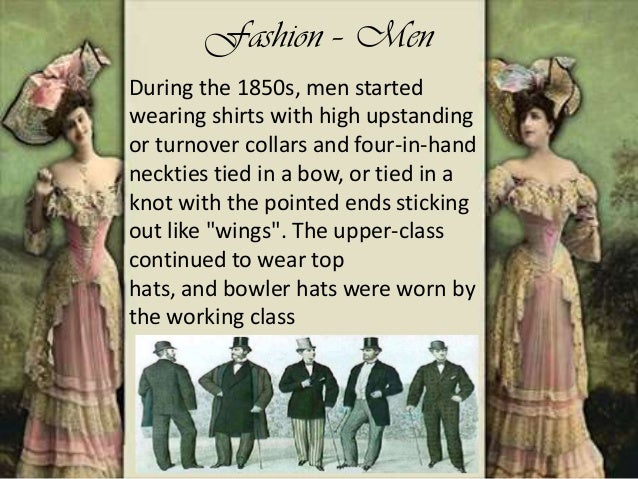
Starting from the 1890s, the blazer wasintroduced, and was worn forsports, sailing, and other casual activities.Throughout...
Taken from "Fashion in the Victorian Era and Regency Period"
https://www.slideshare.net/shahansaheed/presentation1hghgfhhgdhghh
            “Everything in readiness, Uncle Tom took up his gun, remarking, ‘Old Betsy, you have never failed me. Now do your best.’ Seating himself in a chair he rested the gun on the railing, took aim, pulled the trigger. Uncle Tom was picked up at the other end of the piazza, and the gun went cavorting through the air, and landed on the other side of the street. The hat, not a piece of it as big as a ten cent piece, could be found in the whole town. ‘Snaked by jings,’ exclaimed Col. Cowper. ‘A conspiracy—some one has played fool on me, but I’ll set ‘em up.’ All were invited to a saloon near by, where he arranged with the proprietor for drinks for the crowd. The Colonel then went to the hotel to get his dinner, and about two o’clock p.m. the line was formed, and the drinking commenced. They would go in at the front door, get a drink, and pass out at the rear.
            “About sunset the colonel went over to settle the bill, when to his astonishment, the drinking was still going on. The line had resolved in a ring, and was repeating, and ever and anon there would go up a yell, ‘Rah for Cowper.’ He called a halt on the bar-tender, who, knowing the Colonel’s ability to pay, was keeping the glasses filled. He asked for the amount of the bill. The proprietor told him it would take some time to count it up, as he had chalked it down on the side of the house. The Colonel asked how many barrels they had drank, and was told about two. He said he would pay for it at wholesale prices, and it was compromised for $117.50.
            “Colonel Cowper became so disgusted with the whole affair that he resolved to give up the study of law, and immediately packed his trunk, and hired a man to take him to the railroad. Just outside the town, on ascending a hill, an obstruction was noticed in the road. The driver got down to see what it was, and reported that a cart was bottom upwards. They took hold to remove it, when a voice underneath stammered out, ‘Hic: come in boys, free treat—rah for Cowper.’
            “Reaching the station, the colonel took the first train for Raleigh, (Wake County) where he opened an insurance office, and he is today considered one of the best and most reliable insurance men in or out of the State.”

[From the News and Observer (Raleigh, NC) 8 April 1897]

*Pulaski Cowper (1832-1901) was the son of  Lewis Meredith and Annice Collins Cowper. He grew up in Murfreesboro, Hertford County and studied law under Thomas Bragg of Jackson, Northampton County. He became private secretary to Thomas Bragg when he became governor. During the Civil War, he was clerk to Gen. Mallet in the conscript Dept. in Greensboro. After the war, he became involved in the insurance business, and for a number of years was the president of the North Carolina Home Insurance co. of Raleigh. 

            Cowper write for the University Magazine in Chapel Hill and for several newspapers. He also wrote biographies of Gov. Bragg, Judge David Caldwell, and compiled letters of Gen. Bryan Grimes to his wife during the war.


Thursday, November 15, 2018


Root Hog or Die

        I have come on foot-back to fill my engagement (at Goose Creek, Pamlico County). I did not think when I left home yesterday, after finishing my week’s washing, that I would find such an assemblage of ladies and gentlemen, boys, girls and children. As I started to remark before I commenced, that as Mondays are my wash days, I could not get here any sooner on account of yesterday being ironing day and it did seem to me that my wife and daughters had more frocks, more petticoats, more dresses than any wash day ever before. I told my wife that she ought to have put off washing till later as I had been invited to deliver my famous address on the great and well known subject: “Root Hog or Die, or Words to That Effect.”
            Yes, ladies and gentlemen, I am glad to see you out today in such great numbers. Why, this hall is nearly full and I must say this is the largest audience I have had since I have been a stump speaker.
            There’s only one thing that worries me, my devoted friends, and that is that everlasting wash day. Every Monday morning, like the sun, that wash day comes around, and if I don’t get rid of it soon it will carry me to an early grave although I carry gray hairs of sorrow and trouble on my brow and fifty-four years of age to my credit. Still I live in hopes that some day I will either break my arm or have consumption and that pest of a wash day will be a thing of the past and a joy forever, amen.
            But like the North Carolina hog, I have got to root or die. Therefore, in order to save my bacon and also make money enough to be able to hire someone to do the family washing, I have taken to lecturing. And what a time I have. At times I have to walk to the speaking place, but that is on account of the committees who have to meet me failing to do so. Then, again, after hearing my lecture it is almost impossible to get board, and I have to leave between two suns. That is humiliating, but I’d rather do that than get in a wash tub, wouldn’t you?
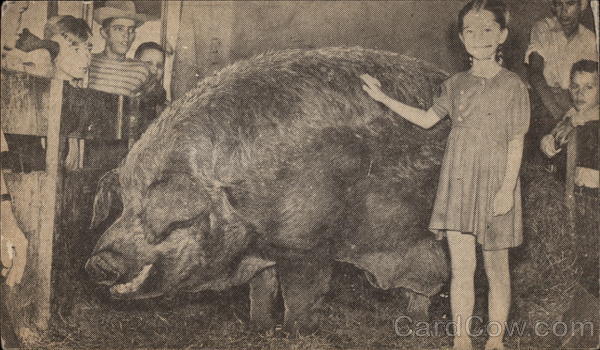
            Now, what we need, ladies and gentlemen, is a hog that doesn’t root. If there had not been rooters this subject of mine would not have been known to fame and fortune. It is said, so Col. Fred Olds* says (Col. Olds is one of the best known men in the United States) that the origin of “Root Hog or Die” was started by Senator Butler. It is said that a good many years ago Col. Butler had a hog that was seven feet long and sixteen hands high or sixteen feet high, I forget which Col. Olds said, and Col. Butler used this hog as a fox-horse. That is, he rode him like a horse, saddle, bridle and all, and there wasn’t a horse in Sampson County that could beat him running. 
Image result for hog largest
https://www.cardcow.com/298743/worlds-largest-hog-animals-pigs/
            Col. Olds says this hog has been known to jump a ten-rail fence and never touch a rail. Well, time passed on, as time and wash days have a right to do, and this famous hog-trotter became old, as usual, and Col. Butler turned him loose in the huckleberry swamps with this parting injunction: “Good-bye, old hog. You will have to root now or die!” And the poor hog was turned away from his home in all his sins and a warm bed into the wide, wide wicked world and huckleberry swamp to root or die. Not a friendly voice to cheer him on his aged days. …

* [Frederick Augustus Olds, 1853-1935, historian, newspaper columnist, lecturer, and editor, was born in Pitt County, North Carolina. ]

[Taken from the Raleigh Post (Raleigh, NC) 5 April 1900
The author was not named.]

Saturday, July 7, 2018


Massive Storm Creates Inlets
Outer Banks of North Carolina
1846

            It was the middle of the night when the tempest first descended on the lower Outer Banks without warning. The shrieking winds and thundering waves made sleep impossible for the people who lived up and down the narrow islands. The storm continued from September 7th to September 9th, 1846, destroying property, wreaking havoc on unsuspecting ships at sea, and cutting two new inlets between the Atlantic Ocean and the North Carolina coast.
            In a12/21/2017 article, Birth of Two Inlets: Accounts of 1846 Storm, Kip Tabb wrote:         “[O]n Monday, Sept. 7, Portsmouth Island [was] battered. Sarah Clark was there, visiting friends, and the letter she wrote to her husband, Samuel, gives a chilling firsthand account of the storm’s severity. ‘You could hear the tide slopping against the floor; you cannot imagine how bad it did sound. The inhabitants say that it was the hardest wind that they have had in twenty years. The highest tide was at ebb. They say that it would have been one and a half foot higher if it had been flood … I can count ten or twelve vessels ashore around here and I have not heard how many on Ocracoke.’”
            According to Early American Hurricanes, 1492-1870 by David M. Ludlum, “the small community of Hatteras just south of the Cape had all but six houses flattened by the storm. At Nags Head the tide rose about 9 ft higher than common tide (Ludlum. 1963).
            “…On Sept. 8, 1846, Calvin Midgett, an Outer Banks farmer, fisherman and part-time employee of the U.S. Coast Survey, [who lived at Hatteras] … watched helplessly as the fury of the hurricane created Oregon Inlet at his home’s doorstep. … A sudden squall came from the southwest, and the waters came upon the beach with such fury that Mr. Midgett, within three quarters of a mile of his house when the storm began, was unable to reach it until four in the afternoon. He sat upon his horse, on a small sand knoll, for five hours, and witnessed the destruction of his property, and as he then supposed of his family also, without the power to move a foot to their rescue, and, for two hours, expecting every moment to be swept to sea himself.
            “Midgett’s house was damaged; his family members, though, were alive and well. …”
Other Eye Witness Accounts
            Reuben Quidley lived through the hurricane and remembered it vividly many years later. Quidley lived in the village of Hatteras and piloted vessels through the inlet at Ocracoke. Before the storm, he always walked along the beach from Ocracoke to his home at Hatteras. There was no open water between the two villages except in the heaviest of storms. After the storm, the villages of Hatteras and Ocracoke were separated by a wide swath of water.
            In New Bern Daily Journal on April 15, 1888, Quidley told the reporter that the tide was waist deep in his house and he expected to be swept away. During the night, when he and his family had lost all hope, the tide suddenly went down and he knew something great had happened, but he did not know what; but in the morning he found the water 25 feet deep where there had been a high beach the day before … . [As the water was drawn out of the creeks and bays, “the tide in Pamlico River was seven feet below normal. The stumps in the bottom of Tranters creek and Chocowinity bay were plainly visible.”
            In a letter to Gov. Jarvis in 1884, Quidley recalled: “The day the inlet was cut out, there were several families living where the inlet is now, and they had no more thought of seeing an inlet there than of any part of the beach, but to their great surprise, in the morning they saw the sea and sound connected together, and the live oaks washing up by the roots and tumbling into the ocean. I was well acquainted with the growth of the land where the inlet now is. I lived with my brother where the inlet is now. I have worked with him cutting wood and chopping yaupon where now, I have no doubt, there is three or four fathoms of water; the growth was live oak principally, did not grow tall, but large trunks and spreading limbs. I had an old uncle lived about where the inlet is, who had a fine fig orchard, and many peach trees on his lot, with fine potato patch and garden.”

            Another witness to the hurricane was H. B. Ansell who lived on Knotts Island near the Virginia border. He recalled that an earlier spring storm had already devastated the coastline. “On the 8th day of September, of the same year (1846), another storm arose. It was said it blew stronger than the previous one, and would have done the same damage if there had been anything left to damage. The few cattle and hogs put on the marshes and beach from the high land and gotten during summer from elsewhere were swept away as before. …
            “The sound, and especially the island bay, kept salt and saltish for years thereafter, so much so, that small oysters were found along the bay shore.
            “Schools of porpoise promenaded daily the island channel and many kinds of salt water fish were abundant.”
At Sea
            An article in The Raleigh Register on September 22, gives the particulars of the damage to shipping caused by the storm.
            The U. S. brig Washington had spent a month along the eastern U. S. coast charting the Gulf Stream. As they made their way to the Virginia Capes, “the weather appeared threatening; the wind fresh and blowing on shore, great anxiety was felt to reach an anchorage.” The ship never made it to the Capes of Virginia.

U. S. Brig Washington in 1846 Hurricane
Coastal Review Online
https://www.coastalreview.org/2017/12/birth-two-inlets-accounts-1846-storm/
              Lieutenant Stembel reported later: “Sea and current (forced the vessel) upon Cape Hatteras … the gale, now increased in volume, howled ominously through the rigging, and already our little vessel swaggered under her canvas; the sky was obscured by flying masses of dark clouds; the crests of the waves heaving their dark volumes to the sky, flashed with the ghostly phosphorescent light often observed in storms … the barometer fell rapidly, and everything foretold a terrible strife of the elements.”
            The ship barely survived. “The brig lay over completely on her side; the water boiling over the lee rail. For hours the crew held to the rigging, but around noon a heavy sea broke on board …washing overboard nearly every soul.”
            Most of the officers and men were rescued, but the Captain, George Bache, and 10 crew members were lost in the turbulent sea.
            Badly damaged, the ship remained afloat and was rescued by the USS Constitution days later. The traumatized crew was given 75 gallons of water and 7 ½ gallons of whiskey and a tow to Philadelphia for repairs.
Other Losses
            The Raleigh Register, on Sept. 22, listed ships lost to the storm:
  • Sch’r Charles Slover—from Newbern bound to N. York, loaded with Naval Stores—sunk and bilged.                 
  •  Sch’r Defiance—sunk and bilged.
  •  Sch’r Frances Simpson, of Newbern—sunk and bilged.
  •  Sch’r Sophia Doane—sunk and bilged.
  •  Sch’r Patrick Henry, from Plymouth, bound to West Indies with lumber—sunk and bilged.
  • Sch’r Conquest—bottom up—two of the crew lost.
  • Sch’r Emeline—driven to sea with only two men on board.
  • Two Lighters belonging to Capt. Tilman Farrow—one driven ashore, the other to sea.
  • Sch’r G. C. Merchant—ashore.
  • Sch’r Paragon—ashore, loaded with wheat.
  • Sch’r ______, of Philadelphia, loaded with cork—sunk.
  • Harbor Island Light Boat, Capt. Robinson—ashore.
Two New Inlets
            The September storm permanently altered the coastline, slashing through the fragile barrier islands to create two new inlets: Hatteras Inlet and Oregon Inlet. "A remarkable surge of water, driven by continuous northeast winds, pushed far into the Pamlico and Albemarle sounds, flooding rivers and creeks for miles inland," Merlin S. Berry wrote in History of Northeastern North Carolina Storms ."Then, as the hurricane passed and its winds rotated to the southwest, this massive expanse of water rushed back toward the sea, overwashing the Outer Banks from west to east."
            The Oregon Inlet was named for the first vessel to navigate through it. Catherine Kozak, in The Virginian-Pilot, 11/21/2008, wrote: “Legend has it that the sailing vessel Oregon was caught in the huge storm while it was headed back to Edenton, N.C., from Bermuda. Desperately trying to keep the ship from being swallowed by the sea, the crew was given a reprieve when a tremendous wave lifted the vessel onto a shallow sandbar.
            “As the sun rose, … the weather-beaten Oregon crew members found a huge cut in the island to the east of where they were stranded in Pamlico Sound. Within days, the ocean subsided and the vessel was able to be floated free.”
Pamlico Sound and Hatteras Inlet in 1862
The Sun (New York, New York) ·  Wed, Jan 29, 1862 
Now
            The North Carolina coast has changed immensely since the 1846 storm. However, two reminders remain: Oregon Inlet and Hatteras Inlet. The Hatteras Inlet proved to be a boon to the Outer Banks area. It was easy to get through from the Gulf Stream and it helped commerce to flourish.
            The Oregon Inlet services a number of boats that move between the Gulf Stream and the coast and is the location of the Coast Guard Station. It is spanned by the Herbert C. Bonner bridge. 

Construction on Bonner Bridge replacement
Miami Herald, 2/8/2018
https://www.miamiherald.com/news/traffic/article198607089.html

SOURCES
  1. http://www.chicagotribune.com/sns-hc-history-1846-story.html
  2. “Birth of Two Inlets: Accounts of 1846 Storm” by Kip Tabb 12/21/2017
  3. Coastal Review Online, https://www.coastalreview.org/2017/12/birth-two-inlets-accounts-1846-storm/  12/21/8017
  4. https://en.wikipedia.org/wiki/1840%E2%80%9349_Atlantic_hurricane_seasons
  5. https://www.ncdcr.gov/blog/2013/09/07/two-major-inlets-on-the-outer-banks-date-to-1846  NC Department of Natural and Cultural Resources
  6. HAMPTON ROADS HISTORY by Catherine Kozak, The Birginian-Pilot, 11/21/2008
  7. https://blog.carolinadesigns.com/2017/12/01/oregon-and-hatteras-inlets-and-the-hurricane-of-1846/;
  8. North Carolina’s Hurricane History: Fourth Edition, by Jay Barnes, 2013
  9. NOAA History http://www.history.noaa.gov/hallofhonor/lineofduty.html
  10.  Find a Grave https://www.findagrave.com/memorial/37484104/george-mifflin-bache
  11. http://familyhistory.stembel.org/HURRICANE.htm ;
  12. THE HURRICANE THAT OPENEO OREGON INLET John F. Sanders (1) UNC Sea Grant College Program North Carolina State University Raleigh, Ne 27650
  13. http://nwafiles.nwas.org/digest/papers/1983/Vol08No2/1983v008no02-Sanders.pdf
  14. https://books.google.com/books?id=9LATBAAAQBAJ&pg=PA49&lpg=PA49&dq=they+saw+the+sea+and+sound+connected&source=bl&ots=mA_nw9NDUE&sig=7bhrRT55nabK7Hp5mqI52ADxlNE&hl=en&sa=X&ved=0ahUKEwijuMu-9_3bAhURA6wKHRVzDDAQ6AEILDAB#v=onepage&q=they%20saw%20the%20sea%20and%20sound%20connected&f=false
  15. https://books.google.com/books?id=Ab8_AAAAYAAJ&pg=PA1&source=gbs_selected_pages&cad=2#v=onepage&q&f=false